^Work to pull a chain
^Work to pull a chain
A chain is held on a frictionless table with 1/n of its length hanging over the edge. If the chain has a length L and a mass M. Work required to pull the hanging part back on the table is, 

^Work to pull a chain
A chain is held on a frictionless table with 1/n of its length hanging over the edge. If the chain has a length L and a mass M. Work required to pull the hanging part back on the table is,
^Insect crawling in a hemisphere
Consider an insect crawling up a rough hemisphere. As the insect crawl up the force pulling it down the 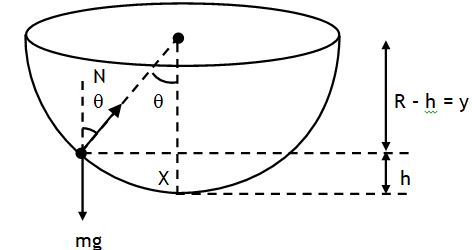
hemisphere i.e. mgsinθ increases where as normal
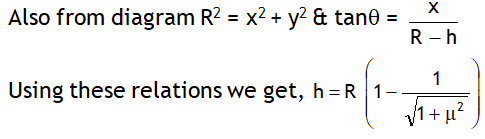
reaction N = mgcosθ & thus limiting friction on it decreases. Let at a height h, mgsinθ is just balanced by limiting friction.
After this height insect tends to slip back. Thus at maximum height reached by the insect.
mgsinθ = msmgsinθ or = tanθ,
^Conical pendulum
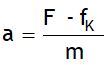
Horizontal component of the tension provides the necessary centripetal force & vertical component balances the weight of the particle.
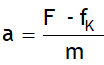
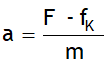
& T cos θ = mg
Using simple rearrangements of above relations we can write following results
^Moderator
The neutrons produced in fission of 235U nuclei have average KE about 2 MeV. Such neutrons are called fast neutrons. These fast neutrons have more tendency to escape instead of triggering another fission reaction. Slow neutrons are more efficient in inducing fission in 92U235 nuclei than fast neutrons. By the use of a moderator, the fast neutrons are slowed to thermal velocities i.e. velocities » 2200 m/s & energies » 0.0235 eV, it is same as that of atoms and molecules at room temperatures, such slow moving neutrons are called thermal neutrons. Light target are better moderators. The commonly used moderator are water, heavy water (D2O), graphite and beryllium. About 25 collisions with deutrons (present in heavy water) or 100 collisions with carbon or beryllium are sufficient to slow down a neutron from 2 MeV to thermal energies.
A good moderator must have:
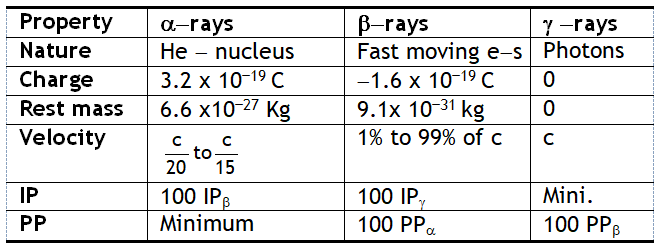
Here IP = Ionizing power & PP = Penetrating power
Also All the three type of rays namely α, β & ϒ affect photographic plate produce flourescence & artificial radioactivity.
^γ-decay
Most radioisotopes, after an alpha decay or a beta decay, leave the daughter nucleus in an excited state, these excited nuclei make a transition to a state of lower energy by emitting a photon. These photons are charge less, mass less & high energy electromagnetic waves (of the order of million electron volt) & are called the gamma rays.
ZXA (unstable nuclei) → ZXA (stable nuclei) + γ
^Recoil of a gun
Before firing, both the gun and the bullet are at rest. After firing, the bullet moves with velocity  and the gun moves with velocity As no external force acts on the system, so using LCLM we get

^β-decay
In the beta-minus decay, a neutron inside the nucleus transforms into a proton with the emission of an electron and anti-neutrino are emitted.

Note, the spins of the neutron, proton and electron are all 1/2. In the beta-plus decay, a proton inside the nucleus transforms into a neutron with the emission of a positron and neutrino are emitted.

^α-decay
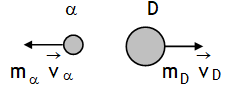
Consider the following decay

As a nucleus decays due to internal force of repulsion, there is no net external force on it, hence in any nuclear reaction linear momentum must be conserved.
Before disintegration, the nucleus can be assumed to be at rest, so the total momentum was zero. After disintegration let it be mava & mD vD for alpha particle & daughter nuclei respectively. To conserve linear momentum the total vector momentum must still be zero i.e. mava + mDvD = 0 or mava = -mDvD
i.e. momentum of a particle must be equal & opposite to that of daughter’s nucleus.
In magnitude, mava = mDvD
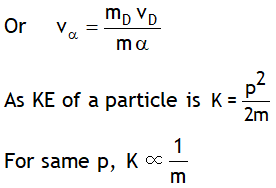
As mass of alpha particle is much lighter than thorium, thus the lighter α particle carries off most of the energy in the form its KE (about 98% of the total KE).
1. A heavy unstable nucleus (e.g. Uranium, polonium, radium, thorium, actinium, etc.) disintegrates itself naturally, spontaneously & randomly without being forced by any external agent to do so until it acquires stability.
2. The disintegration is independent of all physical and chemical conditions and so it can neither be accelerated nor retarded.
3. The disintegration is random. It is purely a matter of chance for any atom to disintegrate first. It is not possible to predict whether a particular nucleus will decay in a given time interval.
4. The activity (or rate of disintegration, A or R) of a radioactive sample at any instant is directly proportional to the number of undecayed nuclei present in the sample at that instant.
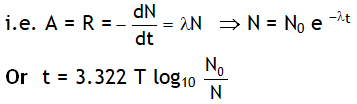
Here λ = disintegration constant or decay constant. & N0 = no. of the atoms present initially i.e. at t = 0.
From above result we can say
5. Half life (T): 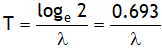
6. Fraction ‘f’ of substance left undecayed after ‘n’ half lives is given by: 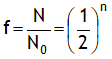
7. Mean life (τ): 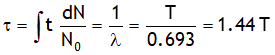
8. Decay constant (λ) is the reciprocal of time for which 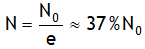
9. λ = 0 for a stable element (e.g. Pb).
10. (a) 1 Bacqueral (Bq) = 1 d.p.s.
(b) 1 Curie (rd) = 3.7 x 10¹⁰ d.p.s.
(c) 1 Rutherford (Rd) = 106 d.p.s.
Here d.p.s. = disintegrations per second.
 Call 9872662552