Posts

^Photodiodes

^Photodiodes

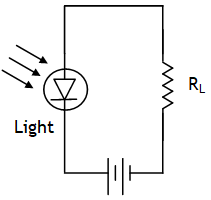
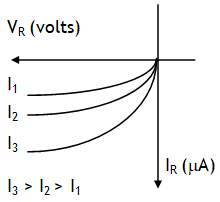
Light incident near the junction of reverse biased (because the fractional change due to the photo-effects on the minority carrier dominated reverse bias current is more easily measurable than the fractional change in the forward bias current) diode produce electron hole pairs which are moved by the junction electric field (electrons towards n end & holes near the p end).

Thus p-side becomes positive and n-side becomes negative giving rise to emf. When an external load is connected, a current flows which can be controlled by changing the intensity of light falling on it. It is used in, light operated switches, optical counters, reproduction of sound from film in move projectors & in photo detectors to detect radiations.

^Solar or photovoltaic cells

^Solar or photovoltaic cells

A solar cell is a pn junction diode generally made from Si or GaAs. It works on following three basic processes: generation, separation and collection:

When sun light of energy   E > Eg falls near the junction (area large) they excite the electrons from VB to CB, leaving behind equal number of holes in the VB. These photo generated electron – hole pairs generated in the depletion region move in opposite directions due to the barrier electric field (electrons move towards n side and holes move towards p side of the junction) & are collected near the side of the diode, which makes the p – side a positive electrode & the n – side a negative electrode & thus a photovoltaic potential difference is developed across the junction. If external load is connected across a solar cell a photocurrent IL starts flowing through it. This current is proportional to the intensity of the illumination falling on the diode.

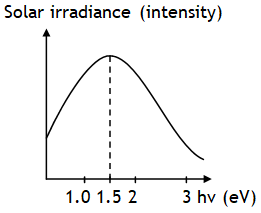
Solar intensity received is maximum near 1.5 eV. As, for photo excitation E > Eg, so, semiconductor with band gap energy Eg ~ 1.5 eV or lower gives better solarconversion energy & thus are ideal materials for solar cell fabrication. Since Si has Eg ~ 1.1 eV while for GaAs it is ~1.43 eV, so they have relatively higher absorption coefficient than other  materials like CdS or CdSe. This is why Si and GaAs are preferred materials for solar cells. Note that sunlight is not always required for a solar cell.
Any light with photon energies greater than the band gap will do.
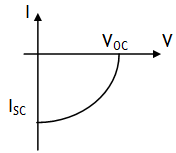
Solar cells are used to power electronic devices in satellites and space vehicles and also as power supply to some calculators.

^LED

^LED

LED means light emitting diode. It is usually heavily doped. On forward biasing the diode majority carriers combine with minority carriers near the junction & emit energy (spontaneous radiation) in the form of visible light. Increase in the forward current results in decrease of light intensity. LEDs are biased such that the light emitting efficiency is maximum. The V-I characteristics of a LED is similar to that of a Si junction diode. But the threshold voltages are much higher and slightly different for each colour. The reverse breakdown voltages of LEDs are very low, typically around 5V. So care should be taken that high reverse voltages do not appear across them. LEDs must at least have a band gap of 1.8 eV (spectral range of visible light is from about 0.4 mm to 0.7 mm, i.e., from about 3 eV to 1.8 eV). The compound semiconductor Gallium Arsenide – Phosphide (GaAs1-xPx) is used for making LEDs of different colours. GaAs0.6 P0.4 (Eg ~ 1.9 eV) is used for red LED. Si (Eg ~ 1 eV), Ge (Eg ~ 0.9 eV), GaAs (Eg ~ 1.4 eV) are used for making infrared LED. LEDs are used in display of watches, calculators, telephones, measuring instruments etc., remotes of electronic devices, decorative items.

^Ripple factor

^Ripple factor

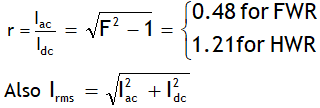
The output obtained from a rectifier is the superposition of both ac & dc components. The ratio of ac component to the dc component in the rectified output is called the ripple factor it decides the effectiveness of a rectifier. i.e.

ac power input

It is the effective input power i.e.

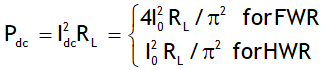
dc power output

It is the effective output power across the load i.e.

Rectifier efficiency

It is defined as the ratio of dc output power to the applied ac input power i.e.

^Moderator

^Moderator

The neutrons produced in fission of 235U nuclei have average KE about 2 MeV. Such neutrons are called fast neutrons. These fast neutrons have more tendency to escape instead of triggering another fission reaction. Slow neutrons are more efficient in inducing fission in 92U235 nuclei than fast neutrons. By the use of a moderator, the fast neutrons are slowed to thermal velocities i.e. velocities » 2200 m/s & energies » 0.0235 eV, it is same as that of atoms and molecules at room temperatures, such slow moving neutrons are called thermal neutrons. Light target are better moderators. The commonly used moderator are water, heavy water (D2O), graphite and beryllium. About 25 collisions with deutrons (present in heavy water) or 100 collisions with carbon or beryllium are sufficient to slow down a neutron from 2 MeV to thermal energies.

A good moderator must have:

  1. low atomic weight
  2. should collide elastically with neutrons.
  3. should not absorb the neutrons


^Comparison of α, β & ϒ  rays

^Comparison of α, β & ϒ  rays

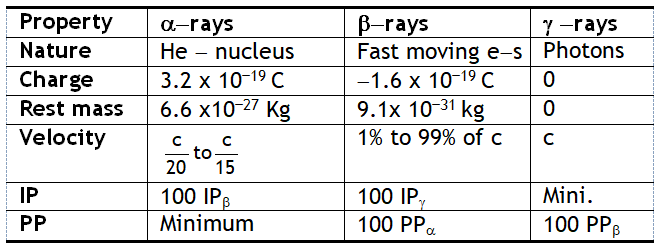
Here IP = Ionizing power & PP = Penetrating power

Also All the three type of rays namely α, β & ϒ affect photographic plate  produce flourescence & artificial radioactivity.

^γ-decay

^γ-decay

Most radioisotopes, after an alpha decay or a beta decay, leave the daughter nucleus in an excited state, these excited nuclei make a transition to a state of lower energy by emitting a photon. These photons are charge less, mass less & high energy electromagnetic waves (of the order of million electron volt) & are called the gamma rays.

ZXA (unstable nuclei) → ZXA (stable nuclei) + γ

^Recoil of a gun

^Recoil of a gun

Before firing, both the gun and the bullet are at rest. After firing, the bullet moves with velocity and the gun moves with velocity As no external force acts on the system, so using LCLM we get

^β-decay

^β-decay

In the beta-minus decay, a neutron inside the nucleus transforms into a proton with the emission of an electron and anti-neutrino are emitted.

Note, the spins of the neutron, proton and electron are all 1/2. In the beta-plus decay, a proton inside the nucleus  transforms into a neutron with the emission of a positron and neutrino are emitted.

^α-decay

^α-decay

Consider the following decay

As a nucleus decays due to internal force of repulsion, there is no net external force on it, hence in any nuclear reaction linear momentum must be conserved.

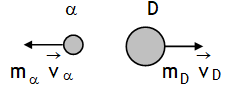
Before disintegration, the nucleus can be assumed to be at rest, so the total momentum was zero. After disintegration let it be mava & mD vD for  alpha particle & daughter nuclei respectively. To conserve linear momentum the total vector momentum must still be zero i.e.  mava + mDvD = 0 or mava = -mDvD

i.e. momentum of a particle must be equal & opposite to that of daughter’s nucleus.

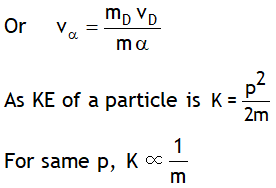
In magnitude, mava = mDvD

As mass of alpha particle is much lighter than thorium, thus the lighter α particle carries off most of the energy in the form its KE (about 98% of the total KE).

error: Content is protected !!
Call 9872662552