*Arithmetic progression
*Arithmetic progression
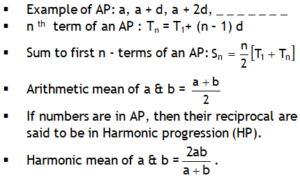

*Arithmetic progression
*Logarithms
Let a is an arbitrary positive real number except 0. If ax = y, then logay = x
Conversely, the antilogarithm of x is the number y i.e. y = antilogax.
Here ax = y is called arbitrary exponential function and loga y = x is read is log of y to the base a is equal to x. If a = 10, log is called common & if it is e, then called natural.
*Cramer’s rule
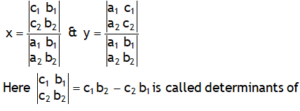
For two simultaneous equations,
a1 x + b1 y = c1 & a2 x + b2 y = c2
*Property of complementary angles.
If α + β = 900, then:
sinα = cosβ, cos α = secβ & tanα = cotβ
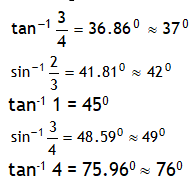
*Commonly used values
^A long horizontal fixed wire carries a current of 100 A. Directly above and parallel to it is another wire carrying a current of 20 A and weighing 0.04 N/m. The separation between the two wires so that the upper wire is just supported by the magnetic repulsion is
 Call 9872662552