Posts

^Parallel combination of resistors

Parallel combination of resistors

The voltage is same across each circuit element is same but current is different & is inversely proportional to resistance of that part.

V = V1 = V2 = V3 = I1R1 = I2R2 = I3R3

&

Fact the maximum number of combination one can have, using all n – resistors at a time is:

(a)  2 (n – 1)      [For n – identical resistors

(b) 2n                    For n – different resistors
^Parallel dielectrics in a capacitor

Parallel dielectrics in a capacitor

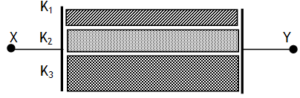
If three dielectric of slabs of same thickness, but different areas of  cross section A1, A2 & A3 , dielectric constants K1, K2 & K3 are placed between the plates of a parallel plate capacitor as shown, then the combination behaves as different dielectrics dividing the plate area are considered as capacitors connected parallel.

Capacitance of this is given by

Cnet = C1 + C2 + C3

^Astronomical Unit (AU)

^Astronomical Unit (AU)

It is the mean distance of the Earth from the Sun.

1 AU = 1.496 x 10¹¹ m » 1.5 x 10¹¹ m


^Uses of dimensions

^Uses of dimensions

  • Correctness of a physical relation can be checked dimensionally. If dimensions of both the sides are found to be same, then the relation is said to be correct otherwise incorrect.
  • Dimension of unknowns can be calculated.
  • A mathematical relation between two or three quantities (called a physical relation) can be derived.
  • Two different system of units can be interrelated.

*Dimensional Constants

*Dimensional Constants

All constants are not dimensionless. The physical quantities which have constant values and dimensions as well are called dimensional constants.

e.g. Planck’s constant, Boltzmann’s constant & Gravitational constant etc.

*One steradian

*One steradian

One steradian (sr)is the solid angle subtended at the centre of a sphere by that surface of the sphere which is equal in area to square of the radius of the sphere.


^Standard integrals

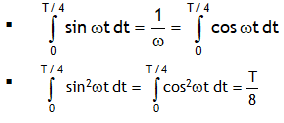
^Standard integrals


^Electrostatic field

Electrostatic field

If the electric field of a charge at a point doesn’t vary with the time, then the electric field is called electrostatic electric field. It’s effect on other charges is studied by defining two quantities; one a scalar field function called electric field potential ‘V’ & second a vector field function called electric field intensity  are related as

Here the –ve sign implies that electric field intensity due to both positive & negative charged configuration is always in the direction of decreasing field potential i.e. from a region of high potential to a region of low potential.

*Rectangular hyperbola

*Rectangular hyperbola

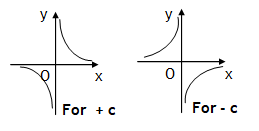
Function xy = c represents a rectangular hyperbola. It meets both x & y axis at infinity only. It is located in quadrant 1 & 3 if c = +ve & in 2 & 4 if c = – ve.

*Vertical line

*Vertical line

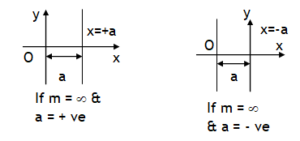
Function x = a represents a vertical line located right side of y axis if a = +ve & left side of y axis if a = – ve.

error: Content is protected !!
Call 9872662552