^One radian
^One radian
One radian (rad) is the angle subtended at the centre of a circle by an arc of length equal to the radius of circle.

^One radian
One radian (rad) is the angle subtended at the centre of a circle by an arc of length equal to the radius of circle.
Gaussian surface
*Geometrical Meaning of integration
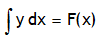 is called Integral or primitive of y w.r.t. x or anti-differentiation.
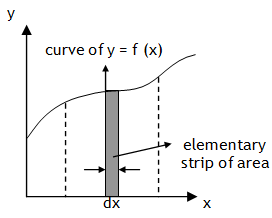
Here, ydx is area of elementary rectangular strip of thickness dx.
Thus  gives the total area bounded by the all the elementary strips of the curve represented by the function
y = f (x) with the x-axis between the limits x = a to x = b. As convention upward areas are taken as positive and downward area negative.
Charge is source of field
*Graph of exponential functions
Functions y = ax, a < 1 & y = a– x, a > 1 are exponentially decreasing. Functions y = ax, a > 1 & y = a– x, a<1 are exponentially increasing.
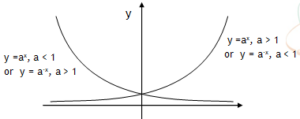
The y intercept of the function y = ax is point (0, 1). If a = e (2.71828) then y = ex is called natural exponential function.
*Right handed or left handed parabola
A quadratic of the form x = ay2 + by + c represents an right handed or a left handed parabola, it can also be expressed by the following function
(y – v)2 = L (x – u)
Here (u, v) represent coordinates of vertex (V) of a parabola. L= +ve for right handed parabola &
L = – ve for a left handed parabola.

*Trigonometric functions
We know following values for sinθ & cosθ.
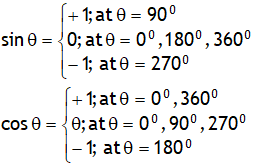
Using these values we can plot the following graphs:
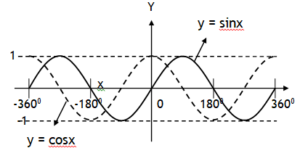
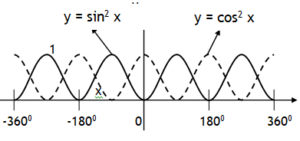
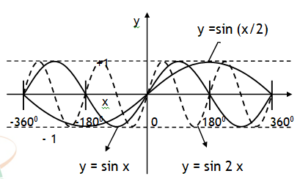
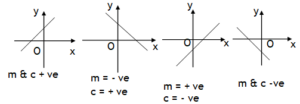
Note the function y = sinx completes one cycle at 3600 where as y = sin2x completes it at 1800 & at
y = sinx/2 completes it at 7200.
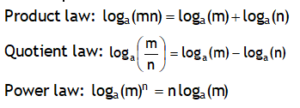
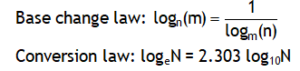
*Laws of log
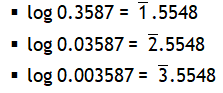
Examples
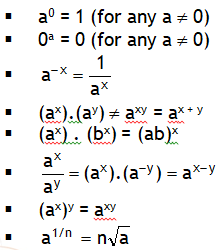
>Laws of exponents
*Harmonic function
Functions which are periodic as well as bounded are called harmonic functions
sinθ & cosθ are harmonic.
 Call 9872662552