^Vector addition law
^Vector addition law
The essential condition for the addition of the two vectors that they should of the same physical nature e.g. force can be added in to force, velocity can be added in to velocity only.

^Vector addition law
The essential condition for the addition of the two vectors that they should of the same physical nature e.g. force can be added in to force, velocity can be added in to velocity only.
Thermoelectric power
The potential difference de across a piece of metal due to temperature difference dT is called the thermoelectric power or the Seebeck coefficient (S) of that material & is defined as,  _ _ _ _ (1)
Its units is V/K. Values in the hundreds of μV/K, negative or positive, are typical of good thermoelectric materials.
Cu voltameter
It consists of a glass vessel containing an aqueous solution of CuSO4 as electrolyte & two copper rods as electrodes. Copper sulphate in aqueous solution dissociated as  .
.
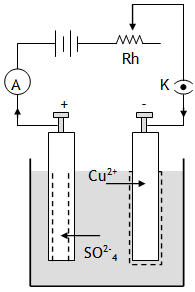
Due to the applied p.d. the SO2-4 ions drift towards the anode & the Cu2+ ions drift towards the cathode.
The SO2-4 ions on reaching the anode react with Cu atoms of anode to form CuSO4. i.e.
Cu + SO2-4 → Cu2+ SO2-4 + 2 e–
Also the oxidation reaction at the anode is
Cu → Cu2+ + 2e–
These Cu2+ ions dissolve into the solution, while the electrons so released flow towards the positive terminal of the battery via the external circuit. The Cu2+ ions on reaching the cathode get neutralized by the electrons flowing in from the negative terminal of the battery i.e. reduction occurs at the anode, Cu2+ + 2e– → Cu.
The net effect of electrolysis is that one copper atom is deposited at the cathode for each pair of electrons flowing through the connecting wires, thus copper is dissolved from the anode and deposited at the cathode in such a way that the concentration of CuSO4 in the solution remains constant & there is no accumulation of charge any where.
^Accuracy & Precision
The accuracy of a measurement is a measure of how close the measured value is to the true value of the quantity. Precision tells us to what resolution or limit the quantity is measured.
For example, suppose the true value of a certain length is near 3.678 cm. In one experiment, using a measuring instrument of resolution 0.1 cm, the measured value is found to be 3.5 cm, while in another experiment using a measuring device of greater resolution, say 0.01 cm, the length is determined to be 3.38 cm. The first measurement has more accuracy (because it is closer
to the true value) but less precision (its resolution is only 0.1 cm), while the second measurement is less accurate but more precise.
Power transferred theorem
The power transferred by a cell to the load is maximum when R = r & given by
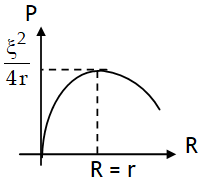
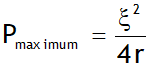
Also then 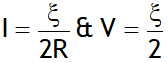
Series dielectrics in a capacitor
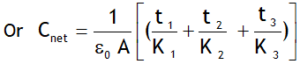
If three dielectric slabs of thickness t1, t2 & t3, dielectric constants K1, K2 & K3 are placed between the plates of a parallel plate capacitor as shown, then the combination behaves as different dielectrics dividing the spacing are considered as capacitors connected in series.
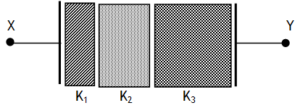
Capacitance of this is given by


^What is a ratio?
If a physical quantity can be completely described just by knowing its only numerical value, no unit & direction is required, then it is called ratio.
e.g. Strain, Poisson’s ratio, refractive index, relative density, relative permittivity, relative permeability, fine structure constant etc.
Facts
Relative velocity have same dimensions as that of velocity where as relative density is dimensionless.
Parallel plates with different charges
If the two parallel metal plates X & Y having charge q1 & q2 are placed close to each other. Let the medium between the plates is air or vacuum. then in order to make net electric field in each plate zero, charges redistribute such that inner faces have equal & opposite charges & extreme faces have equal & of same sign as shown below

Elec. field on the left side (L) of plates, right side of plate (R) & between the plates due to the charge on face a, b, c & d is

*Principle of homogeneity
According to principle of homogeneity of quantities (PHQ) only those quantities can be added or subtracted which have same physical nature.
e.g. Force can’t be added in velocity, similarly or distance can’t be subtracted from time.
Also according to PHQ: L + L = L and L – L = L
L + T = not possible and T – M = not possible.
However there is no restriction on multiplication or division i.e. quantities having same or different dimensions can be both multiplied as well as divided. e.g. v = x/t, F = m.a, P = F/A, W = F.x etc.
 Call 9872662552