Posts

^Accuracy & Precision

^Accuracy & Precision

The accuracy of a measurement is a measure of how close the measured value is to the true value of the quantity. Precision tells us to what resolution or limit the quantity is measured.

For example, suppose the true value of a certain length is near 3.678 cm. In one experiment, using a measuring instrument of resolution 0.1 cm, the measured value is found to be 3.5 cm, while in another experiment using a measuring device of greater resolution, say 0.01 cm, the length is determined to be 3.38 cm. The first measurement has more accuracy (because it is closer

to the true value) but less precision (its resolution is only 0.1 cm), while the second measurement is less accurate but more precise.
^Power transferred theorem

Power transferred theorem

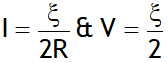
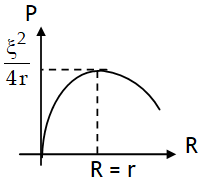
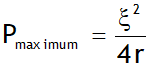
The power transferred by a cell to the load is maximum when R = r & given by

Also then

^Series combination of resistors

Series combination of resistors

The current across each circuit element is same, but potential difference is different & proportional to resistance of that part.

i.e. I = I1 = I2 = I3 & V1 = IR1, V2 = IR2, V3 = IR3 & R series  = R1 + R2 + R3

^Electric resistance

Electric resistance

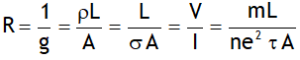
Depends upon the nature of material, shape & size, physical state like temperature, pressure, type & extent of impurity etc. of conductor. However r depends upon all above factors except on shape & size.

^Series dielectrics in a capacitor

Series dielectrics in a capacitor

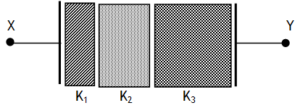
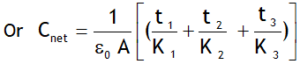
If three dielectric slabs of thickness t1, t2 & t3, dielectric constants K1, K2 & K3 are placed between the plates of a parallel plate capacitor as shown, then the combination behaves as different dielectrics dividing the spacing are considered as capacitors connected in series.

Capacitance of this is given by

^Energy (potential) stored in a capacitor

Energy (potential) stored in a capacitor

A charged capacitor of any shape or size stores energy (potential) in the form of electrostatic electric field, it is given by

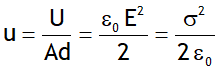
Energy per unit volume is called energy density, it is Electric energy density,

^What is a ratio?

^What is a ratio?         

If a physical quantity can be completely described just by knowing its only numerical value, no unit & direction is required, then it is called ratio.

e.g. Strain, Poisson’s ratio, refractive index, relative density, relative permittivity, relative permeability, fine structure constant etc.

*A quantity having dimensions must posses some units, where as dimensionless quantity can have units. e.g. angle.

Facts

  • *A quantity having dimensions must posses some units, where as dimensionless quantity can have units. e.g. angle.

Relative velocity have same dimensions as that of velocity where as relative density is dimensionless.

^Parallel plates with different charges

Parallel plates with different charges

If the two parallel metal plates X & Y having charge q1 & q2 are placed close to each other. Let the medium between the plates is air or vacuum. then in order to make net electric field in each plate zero, charges redistribute such that inner faces have equal & opposite charges & extreme faces have equal & of same sign as shown below

Elec. field on the left side (L) of plates, right side of plate (R) & between the plates due to the charge on face a, b, c & d is

^Field due to sheets

Field due to sheets

Using Gauss law we can prove that electric field sheets of charge density σ

1. near a infinite sheet or thick sheet

2. near a finite sheet or thin sheet

error: Content is protected !!
Call 9872662552