Posts

^Mutual induction (M)

^Mutual induction (M)

1. Property of a coil due to which it suppress the variations in current in it by inducing a back EMF in the neighbouring coil is called mutual induction. It is measured by a quantity called mutual inductance (M), which is defined as, .

2. SI unit of both self & mutual inductance is henry (H).

3. For two long coaxial solenoid wound on same core,

4. Reciprocity theorem: M12 = M21 

^Commonly used results in electricity & magnetism

^Commonly used results in electricity & magnetism

Electricity Magnetism
Source of field Static or moving charges Moving charges
SI units Charge: coulomb (C)Electric field: Newton /coulomb (N/C) Magnetic pole: ampere meter (Am).Magnetic field is tesla (T)
Field lines Discontinuous: Start at a + ve charge & end at equal -ve charge. Continuous: Have no start or end & are closed loops.
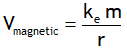
Field due to a mono pole
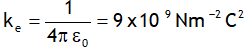
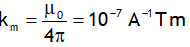
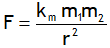
Proportionality constant

(SI units) ke = 1 in cgs units

  in SI unitskm = 1 in cgs units
Force on a monopole
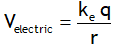
Potential due to a mono pole
Coulomb’s law of two point poles
Screening or shielding Using hollow metallic boxes. Using ferromagnetic boxes.
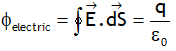
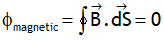
Gauss’s law
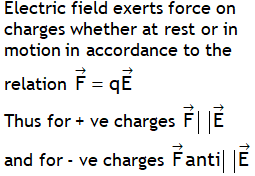
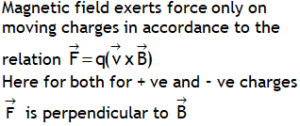
Force exerted by field on charge particles
Trajectories of charged particles in field In electric field:

1.  Straight line if the angle between electric field & velocity of the charges particle is 00 or 1800 &

2.  parabolic if the angle between electric field & velocity of the charges particle is other than 00 & 1800.

In magnetic field:

1.    Straight line if the angle between magnetic field & velocity of the charges particle is 00 or 1800,

2.    circular if the angle between magnetic field & velocity of the charges particle is 900.

3.    helical if the angle between magnetic field & velocity of the charges particle is other than 00, 900 & 1800.

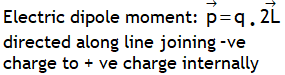
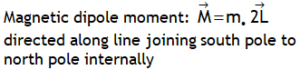
Dipole moment of a dipole of length 2 L
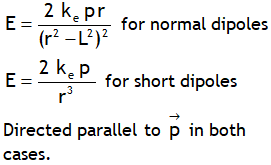
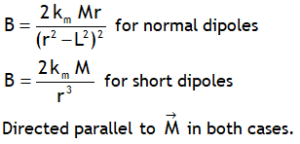
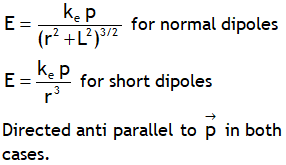
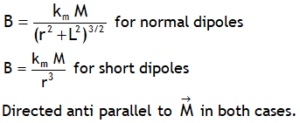
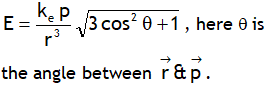
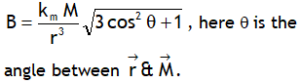
Field on axial line of a dipole
Field on equatorial of a dipole
Field at any point of short dipole
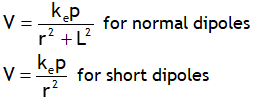
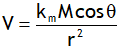
Potential on the axial line of dipole
Potential at any point of short dipole
Force on a dipole placed in a region of uniform field Force on each pole = qE

Net force on dipole = 0

Force on each pole = mB

Net force on dipole = 0

Force on a dipole placed in a non uniform field
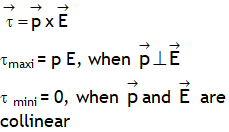
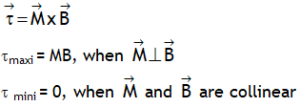
Torque acting on dipole placed in a region of uniform field
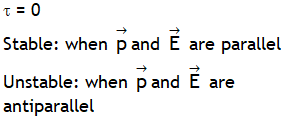
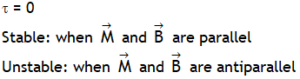
Condition for equilibrium of dipole placed in a region of uniform field
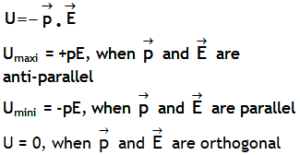
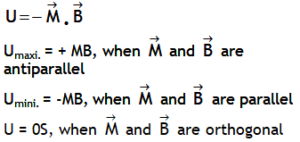
Potential energy of dipole – field system placed in a region of uniform field

^Comparative study of Dia, para & ferro

^Comparative study of Dia, para & ferro

Property Diamagnetic Paramagnetic Ferromagnetic
Physical state Solid, liquid or gas Solid, liquid or gas Crystalline solids only
Atomic dipole moments Zero permanent dipole moment Non – zero permanent dipole moments but oriented randomly Non – zero permanent dipole moments but organised in domains
  Effect of external mag. field Feebly repelled Feebly attracted Strongly attracted
A freely suspended rod in a uniform magnetic field A diamagnetic rod aligns  itself  normal to field A paramagnetic rod aligns  itself along field A ferromag. rod quickly aligns itself  along field
In a non uniform magnetic field Tend to move slowly from stronger to weaker field. Tend to move slowly from weaker to stronger field Tend to move quickly  from weaker to stronger.
Intensity of magnetization  Small – ve Small +ve Large +ve
Relative permeability (μr) 0 ≤ μr < 1 (slightly) μr > 1 (slightly) > 1 Quite large

( ≈ 1012)

Permeability μ < μ0 μ > μ0 μ >>μ0
Mag. susceptibility Small – ve (≈ 1) Small + ve (≈ 1) Large + ve ( ≈ 1012)
B in a medium is More than in diamagnetic Less than in a paramagnetic Much lesser in a ferromagnetic
Dependence of χm on H Independent Independent Independent
Dependence of χm on H χ ∝ T0 (Curie law) (Curie weiss)
Can be explained by Orbital motion of electrons Spin motion of e s (90%) Domain Theory
Transition No Para increases (on cooling) Ferro® para (on heating)
Effect of temperature No effect

(Except Bi at low T)

Decreases Decreases

(T=TC, F → P)

Examples People, frogs, bismuth, copper, gold, zinc, silver, Diamond, graphite, mercury, lead, water, hydrogen, nitrogen (at NTP),NaCl, CO2, benzene & all inert gases. Transition elements, rare earth elements and actinide elements, oxygen gas, air, aluminum, tungsten, titanium, cerium. Iron, cobalt, nickel, gadolinium, dysprosium, Fe2 O3, alnico and alloys containing these elements.

^Dip circle

^Dip circle

Dip circle also called dip needle is a compass pivoted to move about a horizontal axis in a vertical plane containing the magnetic field of the earth i.e. it shows the angle which the magnetic field makes with the vertical. At the magnetic poles such a needle will point straight down.

A compass needle would stay along the magnetic meridian of the place. In some places on the earth there are deposits of magnetic minerals which cause the compass needle to deviate from the magnetic meridian. Knowing the magnetic declination at a place allows us to correct the compass to determine the direction of true north.

^Declination (θ)

Declination (θ)

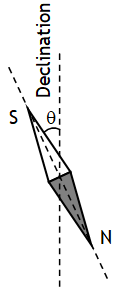
Since the line joining the magnetic poles is titled with respect to the geographic axis of the earth, the magnetic meridian at a point makes angle with the geographic meridian. This angle between the true geographic north and the north shown by a compass needle at which the needle stays in equilibrium in magnetic meridian is called the mag. declination or simply declination.

The declination is greater at higher latitudes and smaller near the equator. The declination in India is small, it being 0º41′ E at Delhi and 0º58′ W at Mumbai. This means a compass needle would deflect towards east by 0 degrees & 41 minute at Delhi & towards west by 0 degrees & 58 minute at Mumbai. As both angles are almost 00, Thus, we can say, at both these places a magnetic needle shows the true north quite accurately.

^Properties of a magnet

Properties of a magnet

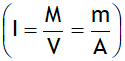
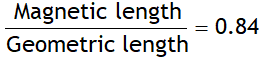
1. The pole strength ‘m’ of a magnet depends upon the nature of material of a magnet, its state of demagnetization & area of cross section of the magnet but is independent of any bend in the magnet.

2. For a bar magnet

3. On cutting a magnet in two identical pieces longitudinally (along the length) the pole strength of each part is halved as a result the dipole moment of each part becomes half.

4. On cutting a magnet in two identical pieces transversally (normal to length) the dipole moment of each part becomes as length of each part is halved.

5. A flexible magnet of length L, pole strength m & dipole moment M is bent into a semi circle. The dipole moment of this semicircle will be .

6. Demagnetization can be due to heating, hammering, passing AC through an electromagnet, applying demagnetizing field (i.e. a magnetic field in the reverse direction), aging.

^Vector addition law

^Vector addition law

The essential condition for the addition of the two vectors that they should of the same physical nature e.g. force can be added in to force, velocity can be added in to velocity only.


^Thermoelectric power

Thermoelectric power

The potential difference de across a piece of metal due to temperature difference dT is called the thermoelectric power or the Seebeck coefficient (S) of that material & is defined as, _ _ _ _ (1)

Its units is V/K. Values in the hundreds of μV/K, negative or positive, are typical of good thermoelectric materials.


^Cu voltameter

Cu voltameter

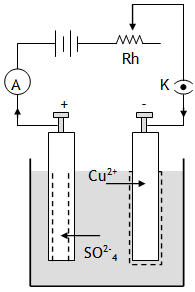
It consists of a glass vessel containing an aqueous solution of CuSO4 as electrolyte & two copper rods as electrodes. Copper sulphate in aqueous solution dissociated as .

Due to the applied p.d. the SO2-4 ions drift towards the anode & the Cu2+ ions drift towards the cathode.

The SO2-4 ions on reaching the anode react with Cu atoms of anode to form CuSO4. i.e.

Cu + SO2-4 → Cu2+ SO2-4 + 2 e

Also the oxidation reaction at the anode is

Cu → Cu2+ + 2e

These Cu2+ ions dissolve into the solution, while the electrons so released flow towards the positive terminal of the battery via the external circuit. The Cu2+ ions on reaching the cathode get neutralized by the electrons flowing in from the negative terminal of the battery i.e. reduction occurs at the anode, Cu2+ + 2e → Cu.

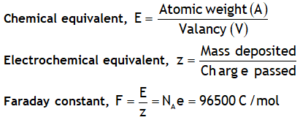
The net effect of electrolysis is that one copper atom is deposited at the cathode for each pair of electrons flowing through the connecting wires, thus copper is dissolved from the anode and deposited at the cathode in such a way that the concentration of CuSO4 in the solution remains constant & there is no accumulation of charge any where.

^Ammeter

Ammeter

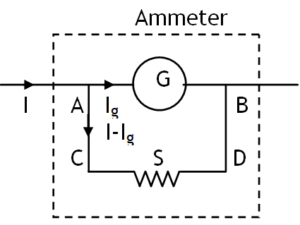
(a) Constructed by connecting small resistance called shunt (S) in parallel to a galvanometer.

(b) Ig G = (I – Ig) S

(c)

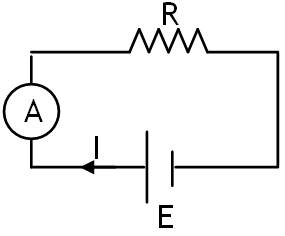
(d) Used in series with the resistor whose current is to be measured.

error: Content is protected !!
Call 9872662552