^Bohr’s model
^Bohr’s model
Bohr’s theory It is applicable for single electron system i.e. hydrogen & hydrogen like atoms e.g. He+, Li2+, Be3+

^Bohr’s model
Bohr’s theory It is applicable for single electron system i.e. hydrogen & hydrogen like atoms e.g. He+, Li2+, Be3+
^Rutherford experiment
In 1911 Rutherford, Geiger & Marsden studied the scattering of alpha particles on passing a narrow beam of alpha particles through a thin gold foil. Conclusions of their experimental in 1913 which led to the discovery of the nucleus.
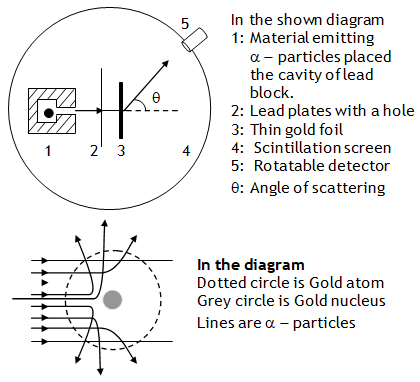
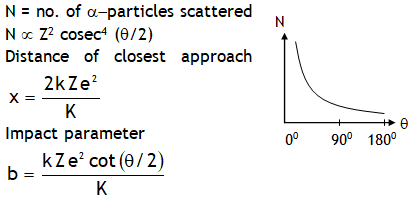
Rutherford’s model discovered nucleus successfully explained the large angle scattering of alpha particles & justified classification of the elements in periodic table but failed to explain about the stability of atom & also failed to explain the line spectrum of H – atom.
^Davisson & Germer experiment
This experiment (1927) established the wave nature of slow moving electrons. In this method a fine beam of accelerated electrons is allowed to strike normally on the nickel crystal and then the intensity of scattered electrons in a given direction is found by using a rotate able detector at various scattering angles. Comparing the wavelength of scattered electrons using Bragg’s law & De – broglie the wave nature of electrons can be confirmed.

^Pair annihilation
It is the reverse of pair production effect. Experiments reveal that when a positron passes through matter & sees an electron and the two come together under the influence of their internal electric attraction, may form an atom like configuration called positronium, where they rotate around each other about the centre of mass & ultimately come close together and annihilate (vanish) each other in a time of the order of 10-10 s & the lost mass becomes the electromagnetic energy in the form of two gamma ray photons, each moving away from the other with energy 0.511 MeV in opposite direction such that both energy & linear momentum is conserved.

^Pair production
Actually 1.02 MeV is the rest mass energy of a pair of Electron & positron. If the energy of photon striking the nucleus is greater than 1.02 MeV, then this excess energy is shared equally by the Electron & positron as the KE. Pair production effect can’t take place in vacuum. As it is impossible for pair production effect to conserve both energy & momentum if it take place in vacuum.
^Pair production effect
When a photon of energy atleast 1.02 MeV interacts with a nucleus a pair of particles (one electron & one positron) is produced. This is called Pair production effect. The probability of the Pair production effect increases with energy of photon striking the nucleus & atomic number of the target nucleus.
γ + Nucleus → e+ + e–
^Photocell
Also called electric eye works on the photoelectric effect. Its electrical properties are affected by the amount of light.
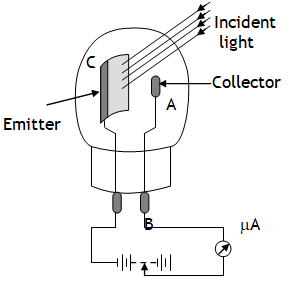
It can be used as light meters to measure the intensity of light in scientific work. In the reproduction of sound in motion pictures and in the television camera for scanning and telecasting, as burglar alarm, as fire alarm, as automatic door, opener, in electronic ignition circuits, as automatic counter to count the no. persons entering an auditorium.
^Photoelectric current
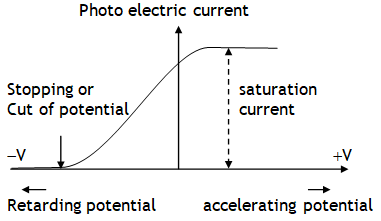
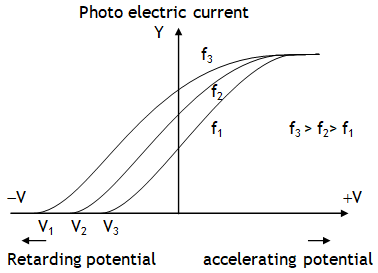
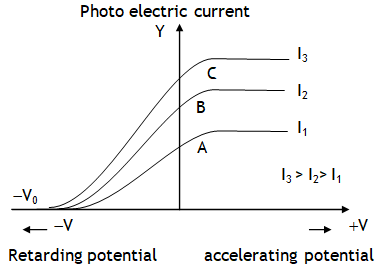
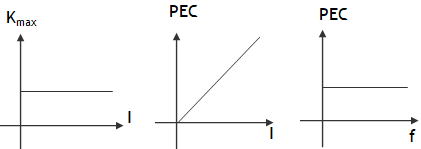
For a given metal & frequency of incident radiations the no. of photo electrons ejected per second is called photoelectric current it is directly proportional to the intensity of incident light but independent of energy of incident light.
^Kinetic energy of the photoelectrons
The kinetic energy of the photoelectrons varies from 0 to Kmax. Maximum KE of photoelectrons is independent of intensity of incident light but depends upon energy or frequency of incident light. It is given by Einstein’s photoelectric equation
Kmax = h(f inci. – fth) = eVs

Stopping potential versus incident frequency

^Photoelectric effect
1. An instantaneous process (10-8 s) of emission of free electrons from the surface of a metal (also called cathode) when light photons of energy greater than threshold frequency are incident on it.
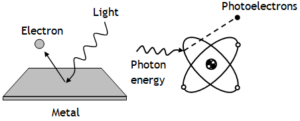
2. Einstein experimentally confirmed that the Photoelectric effect is a one-photon-one electron process & verifies the quantum nature of light as it is the result of particle-particle interaction.
3. Threshold energy (or work function) is the least energy required by an electron to come out of the metal. Its value is few eV & it depends only on the nature of metallic surface & impurities present in it & is independent of the energy or incident photons. W = W0 = E th = hf th.
4. Alkali metals like Li, Na, K, Cs, Rb etc. show PEE with visible light. Metals like Zn, Cd, Mn etc. are sensitive only to UV-light. Cs (Cesium) is the best photosensitive metal.
 Call 9872662552