Posts

^Equipotential surfaces

Equipotential surfaces

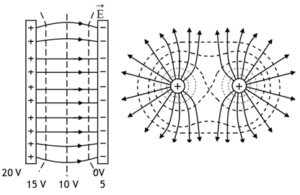
  1. An equipotential surface is an imaginary surface on which every point has one and the same value of electric potential. It can be curved or plane surfaces.
  2. No work is done in moving any charge over an EPS.
  3. Electric field is always ⊥ to EPS.
  4. EPS tells us about direction of electric field.
  5. EPS helps to distinguish regions of strong field from that of weak field. As the separation between two equipotential surfaces is more, where the field is weak & vice – versa.
  6. No EPS can intersect each other.

*Maxima & minima

*Maxima & minima


^Dielectric constant

Dielectric constant

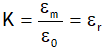
Dielectric constant is also called relative permittivity or specific inductive capacity & is defined as

K = 1 (air or vacuum), K = 81 (water),

K = ∞ (metals), K = 0 (insulator)

Dielectric constant decreases on heating.

*Graph of logarithmic function

*Graph of logarithmic function

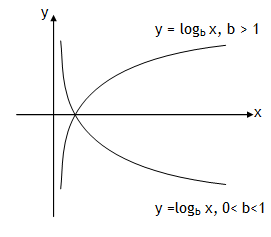
The function y = logb x is called a logarithmic function, it is not defined for x ≤ 0.

It is a decreasing function for 0 < b & increasing for b > 1.  The y – axis is an asymptote of the curve

y = logb x. The x intercept is the point (1, 0).

*Up or down parabola  

*Up or down parabola

A quadratic of the form y = ax2 + bx + c represents an upward or a downward parabola, it can also be expressed by the following function

(x – u)2 = L (y – v)

L= +ve for upward parabola & L = – ve for a downward parabola.

*Shape of y versus x graph

*Shape of y versus x graph

Let a physical quantity y depends on other physical quantity x, this dependence is called a mathematical function & usually expressed as

y = f (x) (read as y is a function of x).

The dependence of y on x can be visualised by drawing a graph of function y = f (x). While plotting graphs the independent varaible is taken on horizontal line & dependent on vertical line. Shape of y versus x graph depends on the type of function.

Following types of y versus x graphs are frequently encountered in Physics.

*Laws of log

*Laws of log


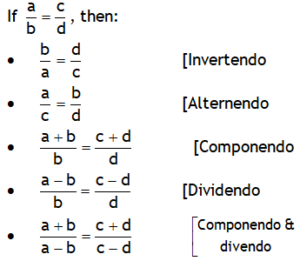
*Componendo & dividendo

*Componendo & dividendo

*Bounded functions

*Bounded functions

If a function attains finite values only, then it is said to be bounded otherwise unbounded.

Only sinθ & cosθ are bounded functions, secθ, cosθ, tanθ & cotθ are unbounded.


*Transformation formulae sinA + sinB = 2sinC cosD

*Transformation formulae 

sinA + sinB = 2sinC cosD

sinA – sinB = 2cosC sinD

cosA + cosB = 2cosC cosD

cosA – cosB = – 2sinC sinD

error: Content is protected !!
Call 9872662552