Posts

^Mutual induction (M)

^Mutual induction (M)

1. Property of a coil due to which it suppress the variations in current in it by inducing a back EMF in the neighbouring coil is called mutual induction. It is measured by a quantity called mutual inductance (M), which is defined as, .

2. SI unit of both self & mutual inductance is henry (H).

3. For two long coaxial solenoid wound on same core,

4. Reciprocity theorem: M12 = M21 

^Commonly used results in electricity & magnetism

^Commonly used results in electricity & magnetism

Electricity Magnetism
Source of field Static or moving charges Moving charges
SI units Charge: coulomb (C)Electric field: Newton /coulomb (N/C) Magnetic pole: ampere meter (Am).Magnetic field is tesla (T)
Field lines Discontinuous: Start at a + ve charge & end at equal -ve charge. Continuous: Have no start or end & are closed loops.
Field due to a mono pole
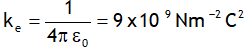
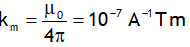
Proportionality constant

(SI units) ke = 1 in cgs units

  in SI unitskm = 1 in cgs units
Force on a monopole
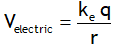
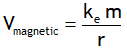
Potential due to a mono pole
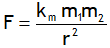
Coulomb’s law of two point poles
Screening or shielding Using hollow metallic boxes. Using ferromagnetic boxes.
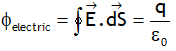
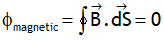
Gauss’s law
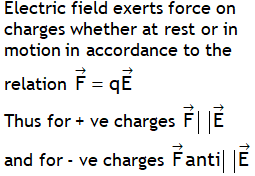
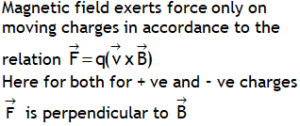
Force exerted by field on charge particles
Trajectories of charged particles in field In electric field:

1.  Straight line if the angle between electric field & velocity of the charges particle is 00 or 1800 &

2.  parabolic if the angle between electric field & velocity of the charges particle is other than 00 & 1800.

In magnetic field:

1.    Straight line if the angle between magnetic field & velocity of the charges particle is 00 or 1800,

2.    circular if the angle between magnetic field & velocity of the charges particle is 900.

3.    helical if the angle between magnetic field & velocity of the charges particle is other than 00, 900 & 1800.

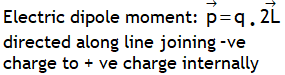
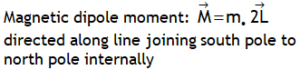
Dipole moment of a dipole of length 2 L
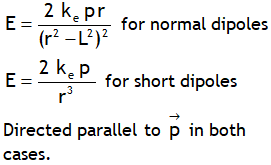
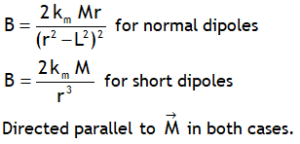
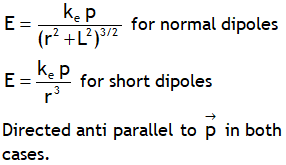
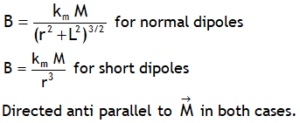
Field on axial line of a dipole
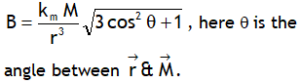
Field on equatorial of a dipole
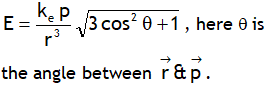
Field at any point of short dipole
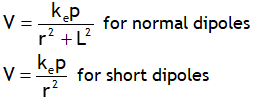
Potential on the axial line of dipole
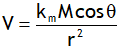
Potential at any point of short dipole
Force on a dipole placed in a region of uniform field Force on each pole = qE

Net force on dipole = 0

Force on each pole = mB

Net force on dipole = 0

Force on a dipole placed in a non uniform field
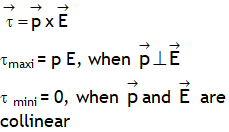
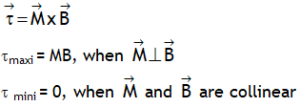
Torque acting on dipole placed in a region of uniform field
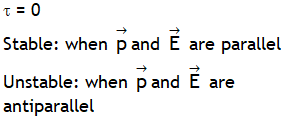
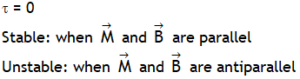
Condition for equilibrium of dipole placed in a region of uniform field
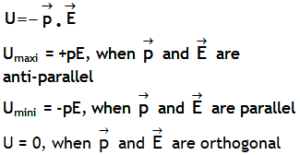
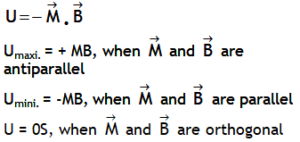
Potential energy of dipole – field system placed in a region of uniform field

^Vibration magnetometer

^Vibration magnetometer

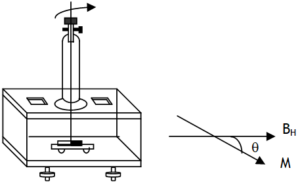
A magnet free to vibrate about vertical axis passing through its CM is first kept in a non- magnetic hook along BH.
On deflecting it slightly by an amount θ, it experiences a restoring torque due to horizontal component of earth’s field BH

τ = M BH sinθ

≈M BH θ   [As sinθ ≈ θ, for small angle deflection.

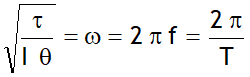
Due to inertia of the magnet it start oscillating simple harmonically. We know from the theory angular SHM that linear frequency, angular frequency & time period of oscillations is,

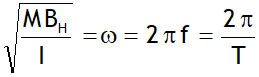
Thus for this situation we have

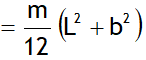
Here, I = MI of the magnet

Uses:

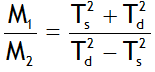
For two dissimilar magnets using

Here Ts = time period for the sum position & Td = time period for the difference position.

^Compass & dip circle

^Compass & dip circle

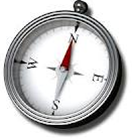
A compass needle consists of a magnetic needle is free to swing (oscillate or deflect) in a horizontal plane about a vertical axis.

A compass needle when placed in a horizontal plane & free to move aligns itself parallel to BH.

At the poles, the magnetic field lines are vertically so that the horizontal component is negligible & the compass needle can point along any direction & thus can’t be used as a direction finder. In that case we use a dip circle.

^Magnetic meridian

^Magnetic meridian

Magnetic meridian at a place is a vertical plane passing through the imaginary line joining the earth’s magnetic north and the south poles or the axis of a freely suspended magnet with its north pole towards geographic north.

^Geographic meridian

^Geographic meridian

Geographic meridian at a point P on earth’s surface is a vertical plane passing through the longitude circle & axis of rotation of the earth.

^Magnetic elements of earth

Magnetic elements of earth

Declination (θ), Dip (δ) &  Horizontal component (BH) are called magnetic elements of earth as earth’s magnetic field can be completely defined in both magnitude & direction by knowing these three.

^Geomagnetism

Geomagnetism

1. Study of magnetic field of earth is called Geomagnetism or terrestrial magnetism.

2. William Gilbert (in about 1600) was the first to demonstrate that the entire earth behaves as an enormous magnet.

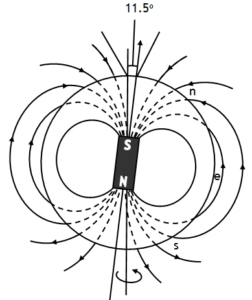
3. The magnitude & direction of Earth’s magnetic field can be obtained approximately by assuming that the earth has a magnetic dipole of dipole moment about 8 x 10²² J/T located at its centre tilted 11.5O from the spin axis of the earth as shown in the diagram.

4. The average strength of the earth’s magnetic field is about half a Gauss. Also Bequator = 30 μT, Bpole = 60 μT. Range of magnetic field is about 5 R from the radius of earth.

5. Earth’s mag. field changes both in magnitude & direction with the time. It is fairly constant over a span of few years but noticeable changes occur in say 10 yrs.

^Motional emf

Motional emf

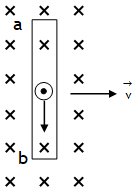
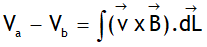
No motional emf will be produced across the conductor if any two vectors are parallel to each other.

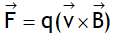
Polarity of the emf can be checked knowing the direction of drift of electrons using .


^Biot–savart’s law

Biot–savart’s law

The magnitude of the magnetic field produced depends upon

  1. strength of current flowing in the conductor
  2. shape, size of conductor &
  3. position of observation point where the field is to be calculated.

Direction of magnetic field due to both straight as well as curved conductor can be calculated by right hand stretched thumb rule. For straight conductor thumb point current & curl of fingers point magnetic lines while in a curved conductor reverse of it. On reversing the direction of current the direction of magnetic field produced is reversed.

error: Content is protected !!
Call 9872662552