^Significant figures
All accurately known digits plus the first uncertain digit of a measurement is called significant digits or significant figures. e.g. if in a measurement, mass of a body lies between 5.6 kg & 5.7 kg & we estimate it as 5.62 kg then the first two digits 5 & 6 are certain while the third digit 2 is approximately known we can say there are 3 significant figures.
Following are the rules for counting significant figures
Rule 1: All non zero digits are significant.
Rule 2: All zeros occuring between two non zero digits are significant.
Rule 3: The digit zero (underlined) conventionally put on the left of a decimal for a number less than one is never significant. All zeros to the right the decimal point are not significant.
Rule 4: The terminal or trailing zero(s) in a number without a decimal point are not significant.
Rule 5: The trailing zero(s) in a number with a decimal point are significant.
Rule 6: The powers of ten are not significant.
Rule 7: No. of significant figures remains unchanged on changing the units of measurement, zeroes appearing in the base number in the scientific notation are significant.
| Example |
NSD |
Using rule |
| 4567 |
Four |
1 |
| 450067 |
Six |
2 |
| 0.004567 |
Four |
3 |
| 456700 |
Four |
4 |
| 0.00456700 |
Six |
5 |
| 4.5 x 10 – 6 |
Two |
6 |
| 5.300 x 10 6 mm |
Four |
7 |


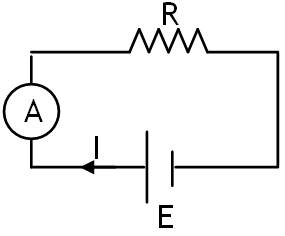


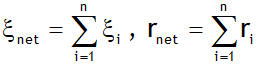
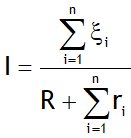
 = constant called electrical resistance R, provided there is no change in the physical conditions like temperature, pressure & impurity etc.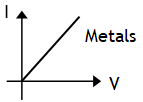
 = (Microscopic version) i.e. conductivity of a conductor is independent of electric field existing in the material over a wide range of field.
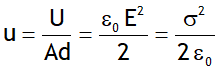
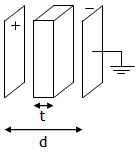
 between the capacitor plates the dielectric gets polarized & an electric equal to E0 is induced in it, as a consequence net electric field in dielectric is found to be zero i.e. Enet = 0.