Posts

^Work done by a electrostatic force

Work done by a electrostatic force

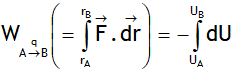
Work done by a electrostatic force ‘F’ in moving a point charge ‘q’ from a point A to point a point B situated in conservative electrostatic field

1. is path independent

2. depends only upon the initial & final positions

3. is equal to loss of potential energy of the point charge between these positions. i.e.
4. zero for a cyclic path.
^Coulomb’s Law

Coulomb’s Law

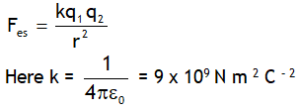
Force of interaction (attraction or repulsion) between two static point charges is called electrostatic forces. For two static point charges electrostatic forces is described by Coulomb’s law

is called electrostatic constant. The quantity eo is called permitivity of free space (vacuum /air). Its value is eo = 8.98755 x 10 –12 N– 1 m – 2 C 2

Dimensions of permittivity: [M – 1 A2 L– 3 T4 ]

Charge which exerts force is called source & which experiences it is called victim.

*Ellipse An ellipse is a closed curve like a circle. An ellipse may be drawn by choosing two points F1 and F2, each of which is a

*Ellipse

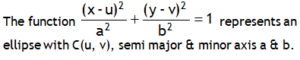
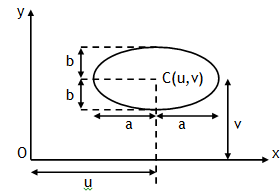
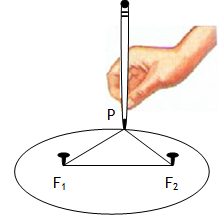
An ellipse is a closed curve like a circle. An ellipse may be drawn by choosing two points F1 and F2, each of which is a called a focus, and then drawing a curve through points for which the sum of the distances PF1 and PF2, respectively, is a constant.

If the center of ellipse is at point origin

Note if a = b, ellipse becomes a circle of radius a.

Area of ellipse = πab

*Parabola is an open figure & can be defined as the locus of a point P which moves in a plane so that its distance

*Parabola

Parabola is an open figure & can be defined as the locus of a point P which moves in a plane so that its distance from a fixed point (called Focus, F) bears a constant ratio (called eccentricity, e = 1) to its distance from a fixed straight line (called directrix).

*Mean of n terms If x1, x2, _ _ _ _ _ _ _ _ _ , xn be n quantities then their

*Mean of n terms

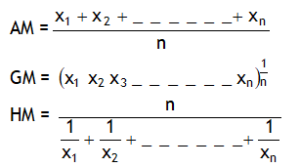
If x1, x2, _ _ _ _ _ _ _ _ _ , xn be n quantities then their

If A, G and H be A.M., G.M. and H.M. between two numbers, then

(a) A ³ G ³ H,(b) G2 = A .H

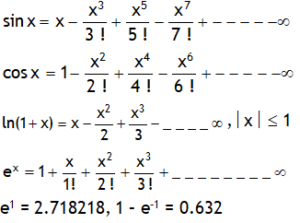
Series

*Characteristic & Mantisa

*Characteristic & Mantisa

The integral part of the logarithm is called Characteristic and the decimal part called Mantisa. Characteristic may be positive, zero or negative. Negative characteristic is, it is represented it with a bar. The mantisa should be positive, if not, we try to make it by rearrangement as illustrated below

log10 N = – 4.5678,

= (- 4 -1) + (1- 0.5678)

= – 5 + (0.4322).

= .4322

*Arithmetic operations

*Arithmetic operations

*Periodic functions A function is said to be periodic if it repeats itself after a fixed period. For a periodic function f (x) there exists a positive number ‘p’ such that

*Periodic functions

A function is said to be periodic if it repeats itself after a fixed period. For a periodic function f (x) there exists a positive number ‘p’ such that

f (x + p) = f (x) for all x.

The smallest such value of ‘p’ is called period.

Periodicity of tan θ & cot θ is π & that of sinθ, cosθ, cscθ and secθ is 2π.

*Semi angle formulae

*Semi angle formulae

<Defining T – ratios 

error: Content is protected !!
Call 9872662552