Conduction
Suppose two charged metal spheres of radii R1 & R2 of different potentials are joined by a metal wire, then charge flows from conductor at higher potential to that at lower potential till both acquire the same potential ‘V’ called common potential. This stage is called steady state & is achieved almost immediately after joining the charged conductors.
1. Common potential at steady state can be calculated using charge conservation i.e. total charge of conductor 1 & 2 before joining
& after joining is same i.e.
q1bj + q2bj = C1 V + C2 V
Or V = V1 aj = V2 aj 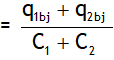
The above relation can be expressed as
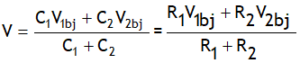
2. Charge on each conductor after joining is
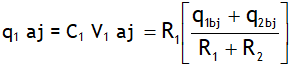
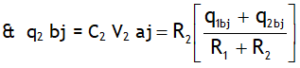
As q = C V & C ∝ R, thus bigger sphere gets more charge after conduction.
3. Total energy of the system before joining is
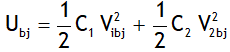
Total energy of the system after joining is
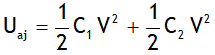
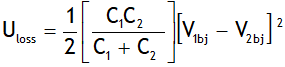
Uaj is found to be smaller than Ubj. The system looses some of its energy in the form of heat, which is given by

 = constant called electrical resistance R, provided there is no change in the physical conditions like temperature, pressure & impurity etc.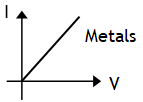
 = (Microscopic version) i.e. conductivity of a conductor is independent of electric field existing in the material over a wide range of field.
 .
.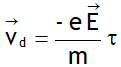 .
.
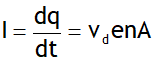
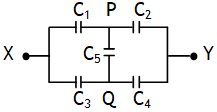
 then points P & Q are at same potential & the bridge is said to be balanced, due to this no charge will flow in the arm PQ & hence arm PQ can be removed & circuit can becomes as shown.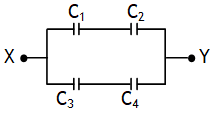
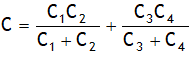 the bridge is not balanced, then the problem can be solved using Kirchoff’s laws.
 e. a capacitor of smaller capacitance will get more potential difference & vice versa.
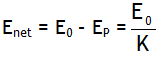
 between the capacitor plates the dielectric gets polarized & an electric
  is induced in it, as a consequence net electric field in dielectric is found to be
  .
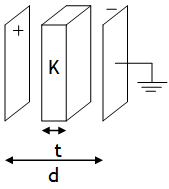
.
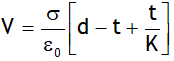 .
.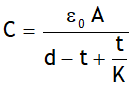 .
. . [using K = 1 and t = 0]
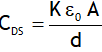 [using t = d]