Posts

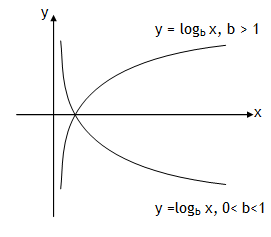
*Graph of logarithmic function

*Graph of logarithmic function

The function y = logb x is called a logarithmic function, it is not defined for x ≤ 0.

It is a decreasing function for 0 < b & increasing for b > 1.  The y – axis is an asymptote of the curve

y = logb x. The x intercept is the point (1, 0).
*Parabola is an open figure & can be defined as the locus of a point P which moves in a plane so that its distance

*Parabola

Parabola is an open figure & can be defined as the locus of a point P which moves in a plane so that its distance from a fixed point (called Focus, F) bears a constant ratio (called eccentricity, e = 1) to its distance from a fixed straight line (called directrix).

*Shape of y versus x graph

*Shape of y versus x graph

Let a physical quantity y depends on other physical quantity x, this dependence is called a mathematical function & usually expressed as

y = f (x) (read as y is a function of x).

The dependence of y on x can be visualised by drawing a graph of function y = f (x). While plotting graphs the independent varaible is taken on horizontal line & dependent on vertical line. Shape of y versus x graph depends on the type of function.

Following types of y versus x graphs are frequently encountered in Physics.

*Characteristic & Mantisa

*Characteristic & Mantisa

The integral part of the logarithm is called Characteristic and the decimal part called Mantisa. Characteristic may be positive, zero or negative. Negative characteristic is, it is represented it with a bar. The mantisa should be positive, if not, we try to make it by rearrangement as illustrated below

log10 N = – 4.5678,

= (- 4 -1) + (1- 0.5678)

= – 5 + (0.4322).

= .4322

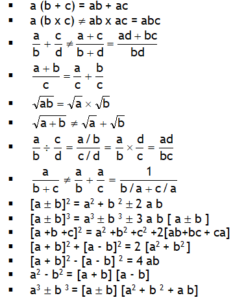
*Arithmetic operations

*Arithmetic operations

*Bounded functions

*Bounded functions

If a function attains finite values only, then it is said to be bounded otherwise unbounded.

Only sinθ & cosθ are bounded functions, secθ, cosθ, tanθ & cotθ are unbounded.


*Transformation formulae sinA + sinB = 2sinC cosD

*Transformation formulae 

sinA + sinB = 2sinC cosD

sinA – sinB = 2cosC sinD

cosA + cosB = 2cosC cosD

cosA – cosB = – 2sinC sinD

<Defining T – ratios 

^A long horizontal fixed wire carries a current of 100 A. Directly above and parallel to it is another wire carrying a current of 20 A and weighing 0.04 N/m.

^A long horizontal fixed wire carries a current of 100 A. Directly above and parallel to it is another wire carrying a current of 20 A and weighing 0.04 N/m. The separation between the two wires so that the upper wire is just supported by the magnetic repulsion is

error: Content is protected !!
Call 9872662552