Posts

^Internal resistance

Internal resistance

Is the obstruction to the free motion of positive & negative ions of the electrolyte by the viscosity of the electrolyte used in the cell. It is zero for an ideal cell. For a freshly prepared cell the internal resistance is very small & its value increases as the cell is put to more & more use. The internal resistance of a cell varies directly with distance of the electrodes concentration of electrolyte polarisation of the cell & varies inversely varies with the area of electrodes. Both emf & internal resistance are different for different cells & depends on the nature of electrolyte & nature of rods used.

^- ve α for electrolytes

– ve α for electrolytes 

Cause of decrease in R with increase in temp. for electrolytes is decrease in viscosity.

^Error in exponential form

^Error in exponential form

Differentiating both sides we can write

The maximum value of fractional error will be

^Temperature variation of resistance

Temperature variation of resistance

On heating a material its resistivity changes, which changes the electrical resistance of the material. The electrical resistivity at temperature T can be calculated by using relation: ρ= ρ0 (1+ αT)

^Resistance of a wire on stretching

Resistance of a wire on stretching

(a) increases n2 times original resistance if length is increased n times.

(b) decreases n4 times if the radius of a wire is increased n times.

Provided mass, density & resitivity wire are kept fixed.

^Resistivity of conductors (ρ)

Resistivity of conductors (ρ)

Resistance per unit length per unit cross sectional area of a material is called its resistivity or specific resistance, for metals it is  (a) .

Its reciprocal is called conductivity or specific conductance (σ). Both ρ & σ are independent of length, thickness, & shape or geometry.

^Current mechanism in conductors

Current mechanism in conductors

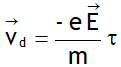
In metals about 10 29 m – 3  of free electrons (called  average number density  ‘n’ ) move randomly (disordered)  in all directions (like motion of gas particles) with average thermal speed of about 105 m/s & collide randomly with the metal ions (almost fixed). Between the collision the free electrons travel along straight lines with average relaxation time (t) of about 10 – 14 s, however due to random motion net charge (electrons) crossing any imaginary plane is zero. On applying external potential difference across a metal an electric field is created in it, which exerts force on electron opposite to the direction of electric field & electron apart from thermal motion (disordered) now start drifting in a definite direction (opposite to the direction of electric field) . Using v – t eqn. the drift velocity of free electrons in metals is .

Average value of drift velocity of free electrons in metals is of the order of few mm /s. Drift velocity per unit applied electric field is called electron mobility (μ) i.e.

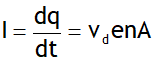
Let ‘n’ be the no. density (i.e. N/V) of free electrons of a metal, then current equation for metal slab of cross sectional area A is

1 A is the flow of 6.25 x 10 18 electrons per second.

^Wheatstone bridge

Wheatstone bridge

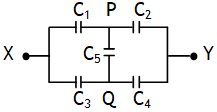
The arrangement of five capacitors as shown is called Wheat stone bridge.

If   then points P & Q are at same potential & the bridge is said to be balanced, due to this no charge will flow  in the arm PQ & hence arm  PQ can be removed &  circuit can becomes as shown.
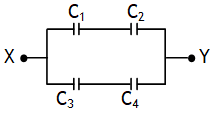
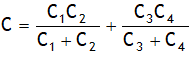
The effective capacitance across the points X & Y for the balanced state of Wheatstone bridge is the bridge is not balanced, then the problem can be solved using Kirchoff’s laws.

^Series grouping of capacitors

Series grouping of capacitors

1. Charge on all the components connected in series is same (i.e. q = constant).

2. Potential difference is divided among the various capacitors in accordance with  e. a capacitor of smaller capacitance will get more potential difference & vice versa.
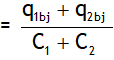
3. Effective capacitance is given by,

^Conduction

Conduction

Suppose two charged metal spheres of radii R1 & R2 of different potentials are joined by a metal wire, then charge flows from conductor at higher potential to that at lower potential till both acquire the same potential ‘V’ called common potential. This stage is called steady state & is achieved almost immediately after joining the charged conductors.

1. Common potential at steady state can be calculated using charge conservation i.e. total charge of conductor 1 & 2 before joining

& after joining is same i.e.

q1bj + q2bj = C1 V + C2 V

Or   V = V1 aj = V2 aj

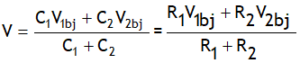
The above relation can be expressed as

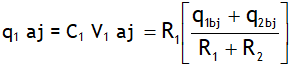
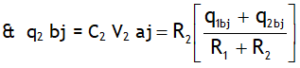
2. Charge on each conductor after joining is

As q = C V & C ∝ R, thus bigger sphere gets more charge after conduction.

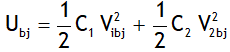
3. Total energy of the system before joining is

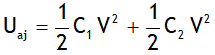
Total energy of the system after joining is

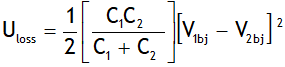
Uaj is found to be smaller than Ubj. The system looses some of its energy in the form of heat, which is given by

error: Content is protected !!
Call 9872662552