Posts

^Moderator

^Moderator

The neutrons produced in fission of 235U nuclei have average KE about 2 MeV. Such neutrons are called fast neutrons. These fast neutrons have more tendency to escape instead of triggering another fission reaction. Slow neutrons are more efficient in inducing fission in 92U235 nuclei than fast neutrons. By the use of a moderator, the fast neutrons are slowed to thermal velocities i.e. velocities » 2200 m/s & energies » 0.0235 eV, it is same as that of atoms and molecules at room temperatures, such slow moving neutrons are called thermal neutrons. Light target are better moderators. The commonly used moderator are water, heavy water (D2O), graphite and beryllium. About 25 collisions with deutrons (present in heavy water) or 100 collisions with carbon or beryllium are sufficient to slow down a neutron from 2 MeV to thermal energies.

A good moderator must have:

  1. low atomic weight
  2. should collide elastically with neutrons.
  3. should not absorb the neutrons
 

^Critical mass

^Critical mass

The minimum of Uranium needed to sustain chain reaction is called critical mass. It is 10 kg.

^Nuclear fuel

^Nuclear fuel

Fissionable material is called nuclear fuel. The isotopes like U-235, Th -232 and Pu 239 can be used as the reactor fuel. A certain mass of the fuel is taken in the form of rods, tightly sealed in Aluminium containers. The rods, separated by moderator are placed in the core of the reactor.

^Uranium enrichment

^Uranium enrichment

The 0.69% U235 is not sufficient to produce a self-sustaining critical chain reaction. To ensure high probability of chain reaction concentration of 235U has to be increased called enrichment. For reactors, the fuel must be enriched to 2.5-3.5%, U-235.

^Natural Uranium

^Natural Uranium

Found as uranium oxide (U2 O3)  which when purified has a rich yellow color and is called “yellowcake”. Uranium has three isotopes namely:

92U238 (99.3%), 92U235 (0.69%) & 92U234 (0.01%).

As the relative of abundance is highest for 92U238, it is called FERTILE. However fission is possible only with 92U235, thus is called FISSILE.

Chemical isotopes that can sustain a fission chain reaction are called nuclear fuels, and are said to be fissile.

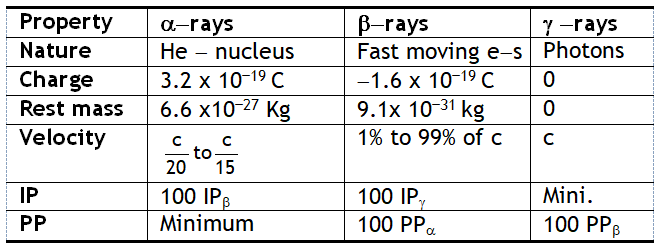
^Comparison of α, β & ϒ  rays

^Comparison of α, β & ϒ  rays

Here IP = Ionizing power & PP = Penetrating power

Also All the three type of rays namely α, β & ϒ affect photographic plate  produce flourescence & artificial radioactivity.

^γ-decay

^γ-decay

Most radioisotopes, after an alpha decay or a beta decay, leave the daughter nucleus in an excited state, these excited nuclei make a transition to a state of lower energy by emitting a photon. These photons are charge less, mass less & high energy electromagnetic waves (of the order of million electron volt) & are called the gamma rays.

ZXA (unstable nuclei) → ZXA (stable nuclei) + γ

^β-decay

^β-decay

In the beta-minus decay, a neutron inside the nucleus transforms into a proton with the emission of an electron and anti-neutrino are emitted.

Note, the spins of the neutron, proton and electron are all 1/2. In the beta-plus decay, a proton inside the nucleus  transforms into a neutron with the emission of a positron and neutrino are emitted.

^α-decay

^α-decay

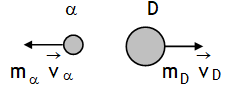
Consider the following decay

As a nucleus decays due to internal force of repulsion, there is no net external force on it, hence in any nuclear reaction linear momentum must be conserved.

Before disintegration, the nucleus can be assumed to be at rest, so the total momentum was zero. After disintegration let it be mava & mD vD for  alpha particle & daughter nuclei respectively. To conserve linear momentum the total vector momentum must still be zero i.e.  mava + mDvD = 0 or mava = -mDvD

i.e. momentum of a particle must be equal & opposite to that of daughter’s nucleus.

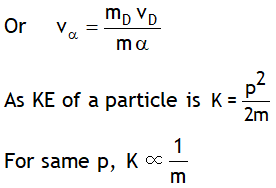
In magnitude, mava = mDvD

As mass of alpha particle is much lighter than thorium, thus the lighter α particle carries off most of the energy in the form its KE (about 98% of the total KE).

^Radioactivity

^Radioactivity

1.    A heavy unstable nucleus (e.g. Uranium, polonium, radium, thorium, actinium, etc.) disintegrates itself naturally, spontaneously & randomly without being forced by any external agent to do so until it acquires stability.

2.    The disintegration is independent of all physical and chemical conditions and so it can neither be accelerated nor retarded.

3.    The disintegration is random. It is purely a matter of chance for any atom to disintegrate first. It is not possible to predict whether a particular nucleus will decay in a given time interval.

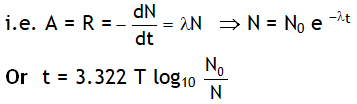
4.    The activity (or rate of disintegration, A or R) of a radioactive sample at any instant is directly proportional to the number of undecayed nuclei present in the sample at that instant.

Here λ = disintegration constant or decay constant. & N0 = no. of the atoms present initially i.e. at t = 0.

From above result we can say

  • The number of active nuclei in a radioactive sample decreases exponentially with time.
  • The disintegration is fast in the beginning but becomes slower and with the passage of time.
  • Irrespective of its nature a radioactive sample will take infinitively long time to disintegrate complete.
  • The larger the value of decay constant l the higher is the rate of disintegration.

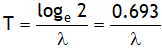
5. Half life (T):

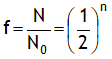
6. Fraction ‘f’ of substance left undecayed after ‘n’ half lives is given by:

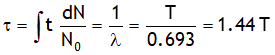
7. Mean life (τ):

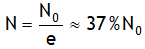
8. Decay constant (λ) is the reciprocal of time for which

9. λ = 0 for a stable element (e.g. Pb).

10. (a) 1 Bacqueral (Bq) = 1 d.p.s.

(b) 1 Curie (rd) = 3.7 x 10¹⁰ d.p.s.

(c) 1 Rutherford (Rd) = 106 d.p.s.

Here d.p.s. = disintegrations per second.

error: Content is protected !!
Call 9872662552