^Intrinsic versus extrinsic SCs
^Intrinsic versus extrinsic SCs
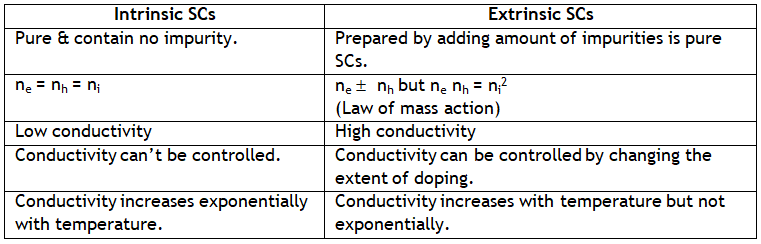

^Extrinsic or doped semiconductors
By adjusting the amount & distribution of doping the conductivity of a SC can be increased to desired amount. Generally the amount of doping is about ppm (i.e. part per million) i.e. one impurity atom is added in 106 pure atoms (i.e. 1016 impurity atoms in 1023 pure atoms per cc). This increases the conductivity more than 103 times.
^Electrical mobility
The drift velocity acquired by a charge carrier in a unit electric field is called its electrical mobility and is denoted by μ. i.e.  . Mobility of electrons in the VB is less than the mobility of electrons in the CB.
Current in a SC is, I = [ve ne + vh nh] e
Conductivity of SC is, σ = e [ne μe + nh μh],
σSi = 10–11 σCu = 10+13sfused quartz
Due to very small number density of charge carriers the conductivity of intrinsic SCs is very low & they are of no practical utility.
^Linear momentum of earth ball system
When a ball is thrown upwards in vacuum an external force equal to its weight acts on it which changes its linear momentum with the time.
However the linear momentum of earth – ball system is conserved & earth moves backward in accordance with LCLM. If we take earth ball as one system, then forces between two are purely internal, consequently the linear momentum of earth ball system remains conserved & we can write. 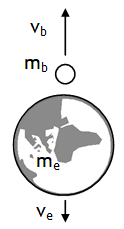
mb vb + me ve = 0

As me >> mb thus recoil speed of the earth is too small to be of significant consideration. Also as the ball moves away from earth, earth moves away from the ball in the opposite direction such that the potential energy of the earth – ball system increase & KE decrease in such a way that mechanical energy of the earth-ball system remains conserved (provided non-conservative force are absent).
^Intrinsic SCs
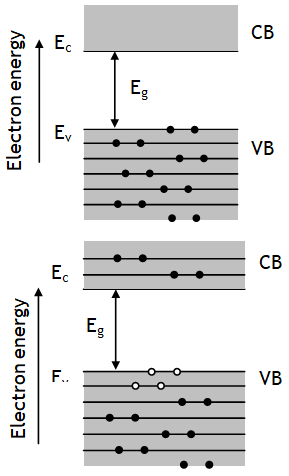
At 0 K the VB of an intrinsic semiconductor is completely filled with the electrons while the conduction band is completely empty as a result a SC behaves like an insulator at 0 K temperature.
However at higher temperatures say at room temperature some of the electrons from the VB gain sufficient thermal energy & jump to CB & occupy some level in the CB in accordance with the extent of the excitation energy. This is called thermal agitation. The vacant spaces left behind in the VB are called holes.
The vacancy of an electron with an effective positive electronic charge is called a hole. It behaves as an apparent free particle with a charge +e. For a intrinsic SC ne = nh = ni
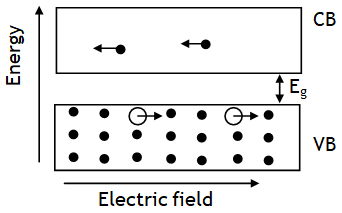
On applying external electric field electrons in the CB start drifting in a direction opposite to the electric field & holes in the VB start drifting in the direction of the electric field due to the force exerted by the electric field as shown in the diagram.
^Energy bands in solids
Energy levels of electrons in an isolated atom are well defined & discrete, however the valence energy levels get modified drastically when atoms interact to form the lattice. If N atoms interact, then total 8 N energy valence energy levels are available which split in two bands (called VB & CB) separated by energy gap (called Eg) as shown in the diagram.
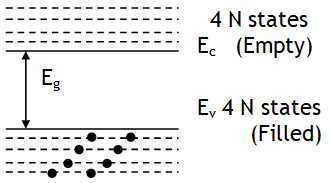
As Eg (Ge) < Eg (Si), thus Ge is preferred in making semi conducting devices.
^Semiconductors
Semiconductors (e.g. Si, Ge) belong to 14th group, thus have 4 valence electrons & hence from covalent bonds (temperature sensitive).
^Absorption radiations
Radiations are absorbed by the materials according to the relation: I = I0 e-μ X
Here μ = absorption coefficient
I = intensity after penetrating the material through ‘x’ thickness of material
I0 = intensity of the radiation before penetrating
Absorption coefficient is highest for Pb.
1. R: Roentgen
2. Rad: Radiation absorbed dose
3. rem: Roentgen equivalent in man
4. RBE: Relative biological effectiveness
 Call 9872662552