Posts

^Wheatstone bridge

Wheatstone bridge

It is the quadrilateral arrangement of four resistors P, Q, R & S connected to a cell & galvanometer G as shown. Here P & Q are called ratio arms, R known arm & S unknown arm.
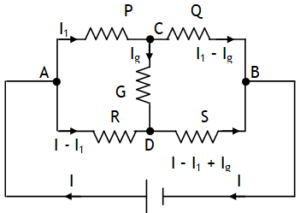
1. If , then VC = VD & the bridge is said to be balanced i.e. the potential difference across the arm CD is zero, consequently no the current through the arm CD & thus arm CD can be removed. Also the position of cell & galvanometer can be interchanged.

2. If , then VC ≠ VD & bridge is said to be in the unbalanced state. If  then current flows from up & if  then current flows down.

3. Wheatstone bridge is said to be sensitive if all the four resistances are of the same order i.e. when the current in the four branches is of the same order. In this case error associated with the measurement of X is mini.
^Galvanometer

Galvanometer

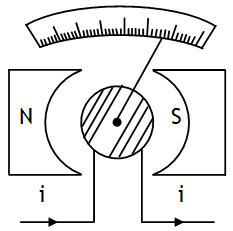
A current carrying coil placed in a magnetic field experiences a torque & deflects.

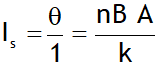
This deflection is calibrated to measure current flowing in it. Used to detect & measure only small currents of the order of microamperes. Current sensitivity (Is): It is defined as the deflection produced for a unit current. i.e. . Is can be increased by increasing B or by decreasing k (by taking quartz or phosphorous bronze). Reciprocal of current sensitivity is called ‘figure of merit’. As we have discussed that a galvanometer fails to measure currents I > Ig. In order to measure currents I > Ig we use an Ammeter.

^CR circuits

With switch S thrown towards A, capacitor undergoes charging in accordance with

With switch S thrown towards B, capacitor undergoes discharging in accordance with

Here CR = t is called capacitive time constant.

Following table is useful to solve problems based on exponential functions.

^Instantaneous velocity

^Instantaneous velocity

Velocity a particular instant is called instantaneous.

At any point instantaneous velocity acts along the tangent at that point. Mathematically it is measured as the limiting value of the average velocity.

For motion along x – axis,   

Initial means, starting time i.e. t = 0

  1. For 1 D motion along x – axis we have,  i.e. instantaneous velocity is equal to slope of position time graph (x – t).

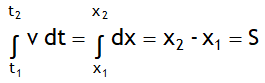
2. On separating the variables & integrating this relation can be rearranged as

i.e. area under x – t graph bounded with the time axis for a time interval is equal to displacement for that time interval.

^n – cells in series

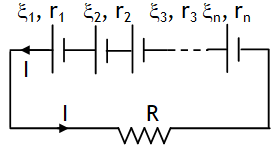
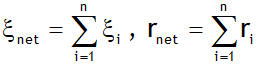
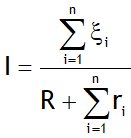
n – cells in series

As all the cell supply current in same direction thus

^Power rating formula

Power rating formula

Resistance of a dc circuit element depends upon its rating in accordance with the relation,

Using above relation we can say

(a) A bulb of thin filament has more resistance.

(b) A low wattage bulb has more resistance (filament thinner) than a high wattage bulb of same rated voltage.

(c) Glow of a bulb ∝ H ∝ I2. In series a low wattage bulb glows more than a bulb of higher wattage while in parallel a high wattage bulb glows more than a bulb of lower wattage.

^Simple circuit

Simple circuit

1. Current delivered by cell:

2. Power dissipated by a load is PR = I2R

3. Power dissipated by a int. resistor is Pd, r = I2r

4. Power generated by a cell is

5. t.p.d. across cell & load is same & is

V = VA – VB = ξ – I r

^Selection of cells

Selection of cells

  1. Leclanche cell for intermittent supply of current.
  2. Daniel cell for constant EMF source.
  3. Lead accumulator for strong current ~ 100 A due to its low r.
  4. Lead accumulator also called acid cell for highest EMF (= 2.05 V) & minimum internal resistance (≈0.01 Ω).
  5. Dry cell for weak current ~ 10 mA.

^Primary cells

Primary cells

Primary cells are those which can’t be recharged.

e.g. Simple voltaic cell (ξ = 1.08 V), Daniel cell (ξ = 1.12 V), Leclanche cell (ξ = 1.45 V) & Dry cell etc (ξ = 1.50 V).

^Internal resistance

Internal resistance

Is the obstruction to the free motion of positive & negative ions of the electrolyte by the viscosity of the electrolyte used in the cell. It is zero for an ideal cell. For a freshly prepared cell the internal resistance is very small & its value increases as the cell is put to more & more use. The internal resistance of a cell varies directly with distance of the electrodes concentration of electrolyte polarisation of the cell & varies inversely varies with the area of electrodes. Both emf & internal resistance are different for different cells & depends on the nature of electrolyte & nature of rods used.

error: Content is protected !!
Call 9872662552