Posts

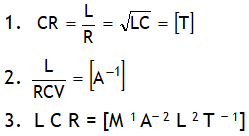
^Also dimensionally:

^Also dimensionally:
Example of LR circuit

Let at t = 0, switch S is closed.
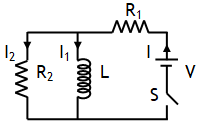
(a) Just on closing switch means t = 0. At this time inductor offers infinite resistance, thus I = 0 and

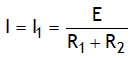
(b) A long time after closing switch means at t = ∞. At this time it offers no resistance (as current in inductor attains a maxima), in other words entire current will pass through inductor, hence at t = ∞, I2 = 0 and
 

^Current in LR – circuit

^Current in LR – circuit

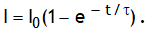
An ideal inductor has no ohmic resistance (i.e. R = 0) it has only reactance (i.e. XL ≠  0). However no inductor is ideal, every inductor can be assumed as series combination of L & R . When such an inductor is connected is connected to a battery (e.g. on throwing switch towards) a current increases exponentially in the outer loop from 0 to become maximum  in accordance with the relation

Due to increase in current voltage across the resistor increases in accordance with the relation


As the total voltage across the LR combination is always fixed & equal to battery voltage, thus the increase in voltage across the resistor implies a decrease in voltage across the inductor. This is described by the function .


On throwing switch towards B current decreases exponentially in the outer loop from maximum to become 0 in accordance with the relation

^Eddy currents

^Eddy currents

Opposing currents produced in the whole volume of a metallic body in the form of closed loops due to the change in magnetic flux linked with a body oppose the change in magnetic flux & can be so strong that the metallic body become red hot.

^Combination of inductors

^Combination of inductors

^Coefficient of coupling (K)

^Coefficient of coupling (K)

It is defined as,

(A) The value of K is 0 < K < 1 for loose coupling (i.e. When the axis of two coils are parallel to each other & on different lines )

(B) K = 1 for tight coupling ( i.e. when two coils are wound on each other).

(C) When the axis of two coils are ⊥ to each other & on different lines K = 0 & this case is called zero coupling.

^Mutual induction (M)

^Mutual induction (M)

1. Property of a coil due to which it suppress the variations in current in it by inducing a back EMF in the neighbouring coil is called mutual induction. It is measured by a quantity called mutual inductance (M), which is defined as, .

2. SI unit of both self & mutual inductance is henry (H).

3. For two long coaxial solenoid wound on same core,

4. Reciprocity theorem: M12 = M21 

^Self induction

^Self induction

1. Property of a coil due to which it suppress the variations in current in it by inducing a back EMF in itself is called self induction. It is measured by a quantity called self inductance (L), which is

2. For a coil & long solenoid

(a) self inductance, L = A l μm n2

(b) Magnetic energy is,

(c) Magnetic energy density is,

3. An inductor (also called a solenoid, or long coil or electromagnet) bent in the form of a coil & made from a thick wire of negligible resisitivity so as to have zero ohmic resistance e. R = 0 is called an ideal inductor or solenoid.

^emf by changing area

^emf by changing area

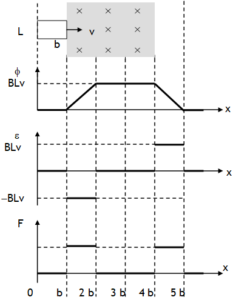
Diagram shows a rectangular loop of length L, breadth b, moved towards a region of uniform magnetic field B at a uniform velocity v.

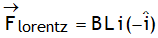
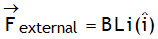
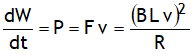
Due to change in magnetic flux with time the emf induced in the loop is, ε = B L v. This causes current  (clockwise) in loop. Due to current magnetic force acts on length. This tends to retard the loop. In order to pull the wire frame with uniform velocity external force is to be applied on the loop. The rate at which the applied force does work to maintain the velocity of the wire frame is . This work done is actually appearing in the form of electric energy in the loop.
^Lenz rule

^Lenz rule

Induced EMF produced in a circuit always flows in a direction so as to oppose its cause (i.e. change of magnetic flux).

^Commonly used results in electricity & magnetism

^Commonly used results in electricity & magnetism

Electricity Magnetism
Source of field Static or moving charges Moving charges
SI units Charge: coulomb (C)Electric field: Newton /coulomb (N/C) Magnetic pole: ampere meter (Am).Magnetic field is tesla (T)
Field lines Discontinuous: Start at a + ve charge & end at equal -ve charge. Continuous: Have no start or end & are closed loops.
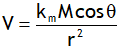
Field due to a mono pole
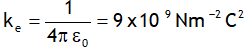
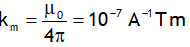
Proportionality constant

(SI units) ke = 1 in cgs units

  in SI unitskm = 1 in cgs units
Force on a monopole
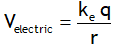
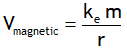
Potential due to a mono pole
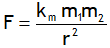
Coulomb’s law of two point poles
Screening or shielding Using hollow metallic boxes. Using ferromagnetic boxes.
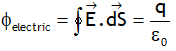
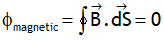
Gauss’s law
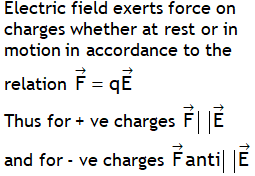
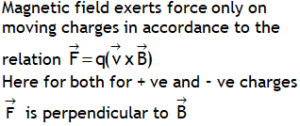
Force exerted by field on charge particles
Trajectories of charged particles in field In electric field:

1.  Straight line if the angle between electric field & velocity of the charges particle is 00 or 1800 &

2.  parabolic if the angle between electric field & velocity of the charges particle is other than 00 & 1800.

In magnetic field:

1.    Straight line if the angle between magnetic field & velocity of the charges particle is 00 or 1800,

2.    circular if the angle between magnetic field & velocity of the charges particle is 900.

3.    helical if the angle between magnetic field & velocity of the charges particle is other than 00, 900 & 1800.

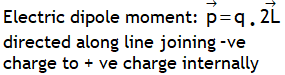
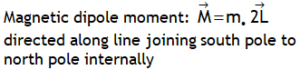
Dipole moment of a dipole of length 2 L
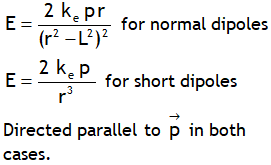
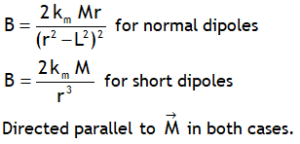
Field on axial line of a dipole
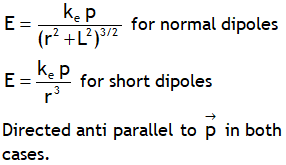
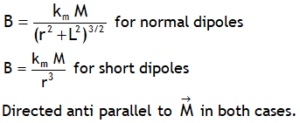
Field on equatorial of a dipole
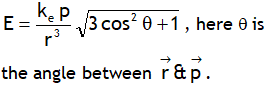
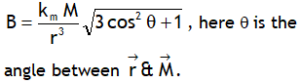
Field at any point of short dipole
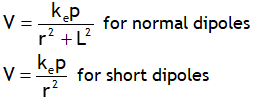
Potential on the axial line of dipole
Potential at any point of short dipole
Force on a dipole placed in a region of uniform field Force on each pole = qE

Net force on dipole = 0

Force on each pole = mB

Net force on dipole = 0

Force on a dipole placed in a non uniform field
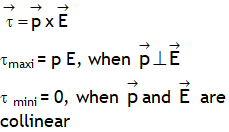
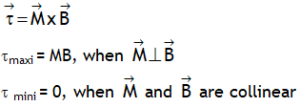
Torque acting on dipole placed in a region of uniform field
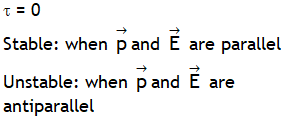
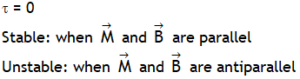
Condition for equilibrium of dipole placed in a region of uniform field
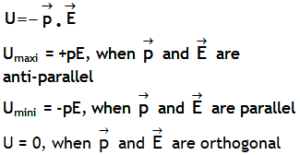
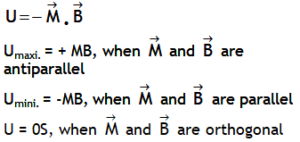
Potential energy of dipole – field system placed in a region of uniform field
error: Content is protected !!
Call 9872662552