^Poynting vector
^Poynting vector
Poynting vector  gives intensity of EM – wave & is defined as:
  SI unit : W/m2

^Poynting vector
Poynting vector gives intensity of EM – wave & is defined as: SI unit : W/m2
^Intensity of EM waves
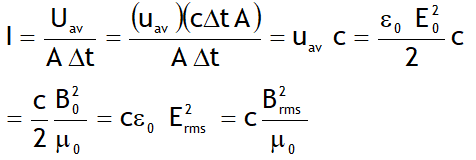
Intensity of EM wave is defined as the average energy crossing per second per unit area perpendicular to the direction of propagation of electromagnetic wave. i.e.

^Total energy density of EM waves
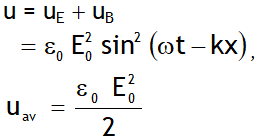
Total energy (u) of EM waves
,
^Magnetic energy density of EM waves
Magnetic energy density (uB) of EM waves is

^Electric energy density of EM waves
Electric energy density (uE) of EM waves is

^Speed of EM-waves
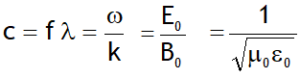
Speed of EM wave depends only upon the electric and magnetic properties of medium & is given by
^Equation of EM-waves
For an EM wave propagating along + X-axis is described by the mathematical functions
EY = E0 sin (ωt – kx), EX = 0 & EZ = 0 &
BZ = B0 sin (ωt – kx), BX = 0 & BY = 0

^Propagation of EM-waves
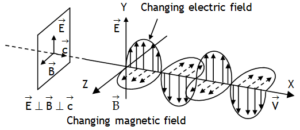
EM waves propagate such that E & B vectors
1. are always in phase
2. vary sinusoidally at right angles to each other as well as it right angles to direction of (DOP) & thus EM waves are transverse.
DOP is in the direction given by 
^Deflection of EM-waves
EM waves are neutral, thus can’t be deflected by E & B fields.
^History of EM waves
In 1865 Maxwell predicted the existence of electromagnetic waves purely from theoretical consideration. He showed that an accelerating charge produce EM waves of wave frequency as that of the oscillating charge.
In 1887, Hertz succeeded in experimentally confirming the existence of em waves. He sued an oscillatory LC circuit for producing these waves he was able to produce and detect e.m. waves of wavelength around 6 m.
In 1885 J.C. Bose succeeded in producing EM wave of much shorter wavelength (5 mm to 25 mm) with the help of a self designed radiator. He was able to transmit EM waves over a distance of about 20 m.
In 1896 Marconi, succeeded in transmitting EM waves across the British Channel in 1899 and across the Atlantic ocean in 1901. His experiments marked the beginning of radio communication.
 Call 9872662552