Posts

^Deviation of the emergent ray

^Deviation of the emergent ray

Incident ray deviates clockwise towards the base at first face by amount δ1 (= i1 – r1) & then again  deviates clockwise towards the base at second face by amount δ2 (= r2 – i2), thus the total deviation of the prism sum of δ1 & δ2 . Also from the cyclic quadilaternal AEHF,

r1 + i2 = A. From this information we can write

δ = δ1 + δ2 = i1 + r2 – A    [Called Prism equation

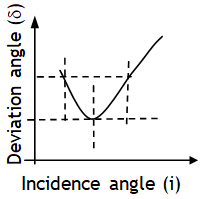
For given μ, λ & A with the increase of incidence angle deviation  angle first decreases &  becomes minimum & then starts increasing as shown in the graph.
^Prism

^Prism

Prism angle A is also called refracting angle & not angle of refraction.

A light ray DE in incident on the first face AB of a prism ABC at an incidence angle i1. The refracted ray EF bends towards the base BC of the prism has a refraction angle r1 & strikes the second face AC of the prism at an incident angle i2. If i2 < C, then the light ray striking the face AC undergoes refraction & emerges out from the prism as the emergent ray FG.

^Normal shift

^Normal shift

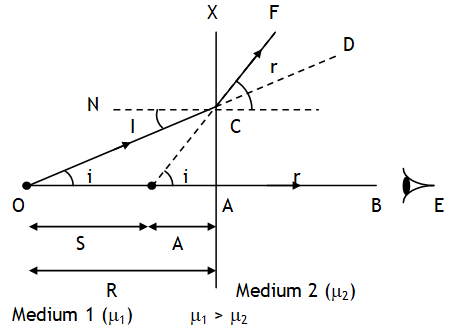
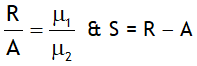
Consider on object O in medium 1 (μ1 > μ2) & observer with eye E in medium 2.

^Critical angle

^Critical angle

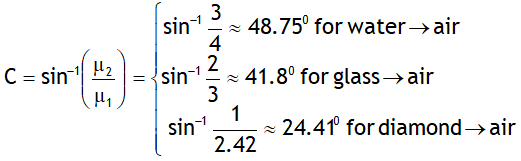
It is that angle of incidence (i = C) at which a ray going from denser to rare medium shows grazing emergence (r = 900).

^Optical path (L)

^Optical path (L)

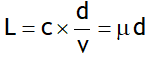
Distance travelled by light in vacuum in the same time in which it travels a given path length in a medium. If light travels a path length d in a medium at speed v, the time taken by it will be d/v.

Thus optical path length

As μ > 1, optical path length is always greater than geometrical path length.

^Refraction

^Refraction

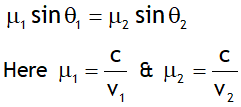
1. Snell’s law is the law of refraction. It is applicable for both plane & curved surfaces. According to this law the product μ sinθ remains constant in any medium. Thus for a light going from medium 1 to 2


When a light wave enters a denser medium (say glass) from a rarer medium (say air)

2. The frequency (f) of the wave & hence the colour of the light wave remains the same

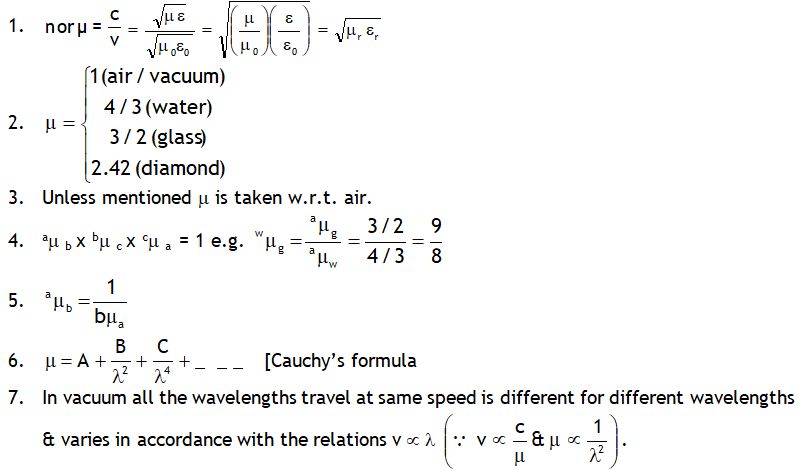
3. But the wavelength of the wave decreases μ times as a result its speed of the light wave decreases μ  times (because v = f λ)

4. However in refraction of light, the amplitude of light may decrease or remain constant.

5. There is no change of its phase i.e. ΔΦ = 0.

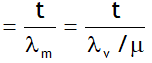
6. No. of waves in ‘t’ thickness of a medium are


^Optical refractive index

^Optical refractive index

^Uses of Convex mirror

^Uses of Convex mirror

  1. As back view mirror in vehicles due to its greater field of view & it always virtual, erect & diminished image for a real object irrespective of the position of the object.
  2. For reflectors in street lamps.
  3. Anti – shoplifting mirrors
  4. In refracting type telescopes.
  5. For decoration purposes (as they form small beautiful images).

^Uses of concave mirrors

^Uses of concave mirrors

  1. By ENT specialists to throw sharp, narrow beam of light into ear, nose & throat for internal examination.
  2. Shaving & makeup mirrors
  3. In search lights & headlamp reflectors
  4. In reflecting type astronomical telescope.

^Uses of plane mirror

^Uses of plane mirror

  1. As looking glass
  2. To bend the path of light
  3. As periscope
  4. As Kaleidoscope
error: Content is protected !!
Call 9872662552