Posts

^Selection of cells

Selection of cells

  1. Leclanche cell for intermittent supply of current.
  2. Daniel cell for constant EMF source.
  3. Lead accumulator for strong current ~ 100 A due to its low r.
  4. Lead accumulator also called acid cell for highest EMF (= 2.05 V) & minimum internal resistance (≈0.01 Ω).
  5. Dry cell for weak current ~ 10 mA.

^Primary cells

Primary cells

Primary cells are those which can’t be recharged.

e.g. Simple voltaic cell (ξ = 1.08 V), Daniel cell (ξ = 1.12 V), Leclanche cell (ξ = 1.45 V) & Dry cell etc (ξ = 1.50 V).

^Internal resistance

Internal resistance

Is the obstruction to the free motion of positive & negative ions of the electrolyte by the viscosity of the electrolyte used in the cell. It is zero for an ideal cell. For a freshly prepared cell the internal resistance is very small & its value increases as the cell is put to more & more use. The internal resistance of a cell varies directly with distance of the electrodes concentration of electrolyte polarisation of the cell & varies inversely varies with the area of electrodes. Both emf & internal resistance are different for different cells & depends on the nature of electrolyte & nature of rods used.

^- ve α for electrolytes

– ve α for electrolytes 

Cause of decrease in R with increase in temp. for electrolytes is decrease in viscosity.

^- ve α for semiconductors

– ve α for semiconductors

On heating semiconductors the number density of free electrons increases & τ decreases. But the effect of increase in ‘n’ is stronger than decrease in relaxation time (τ). Hence net effect is increase in ‘n’ which decreases resistance.

^Temperature variation of resistance

Temperature variation of resistance

On heating a material its resistivity changes, which changes the electrical resistance of the material. The electrical resistivity at temperature T can be calculated by using relation: ρ= ρ0 (1+ αT)

^Resistance of a wire on stretching

Resistance of a wire on stretching

(a) increases n2 times original resistance if length is increased n times.

(b) decreases n4 times if the radius of a wire is increased n times.

Provided mass, density & resitivity wire are kept fixed.

^The magnitude of the difference between the individual measurement and the actual or true value is called the absolute error in the

^The magnitude of the difference between the individual measurement and the actual or true value is called the absolute error in the

measurement of that quantity. It is represented by

The ratio of the absolute error to the actual quantity measured is called the relative error of the measurement.

Relative error 

^Resistivity of conductors (ρ)

Resistivity of conductors (ρ)

Resistance per unit length per unit cross sectional area of a material is called its resistivity or specific resistance, for metals it is  (a) .

Its reciprocal is called conductivity or specific conductance (σ). Both ρ & σ are independent of length, thickness, & shape or geometry.

^Current mechanism in conductors

Current mechanism in conductors

In metals about 10 29 m – 3  of free electrons (called  average number density  ‘n’ ) move randomly (disordered)  in all directions (like motion of gas particles) with average thermal speed of about 105 m/s & collide randomly with the metal ions (almost fixed). Between the collision the free electrons travel along straight lines with average relaxation time (t) of about 10 – 14 s, however due to random motion net charge (electrons) crossing any imaginary plane is zero. On applying external potential difference across a metal an electric field is created in it, which exerts force on electron opposite to the direction of electric field & electron apart from thermal motion (disordered) now start drifting in a definite direction (opposite to the direction of electric field) . Using v – t eqn. the drift velocity of free electrons in metals is .
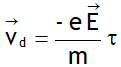
Average value of drift velocity of free electrons in metals is of the order of few mm /s. Drift velocity per unit applied electric field is called electron mobility (μ) i.e.

Let ‘n’ be the no. density (i.e. N/V) of free electrons of a metal, then current equation for metal slab of cross sectional area A is
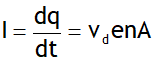
1 A is the flow of 6.25 x 10 18 electrons per second.

error: Content is protected !!
Call 9872662552