Posts

^Circuit to find ‘r’ of a cell

Circuit to find ‘r’ of a cell
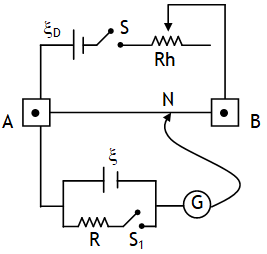
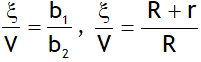
When the switch S is closed & the switch S1 is kept open, then the cell of emf ξ is said to be in open circuit. Let here the balancing length is b1, then ξ ∝ b1 Now when the switches S & S1 are closed, then the cell of emf ξ is said to be in closed circuit.

Let here the balancing length is b2, then V ∝ b2

Dividing above two relations we get
^Wheatstone bridge

Wheatstone bridge

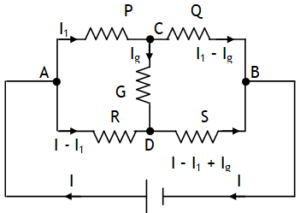
It is the quadrilateral arrangement of four resistors P, Q, R & S connected to a cell & galvanometer G as shown. Here P & Q are called ratio arms, R known arm & S unknown arm.

1. If , then VC = VD & the bridge is said to be balanced i.e. the potential difference across the arm CD is zero, consequently no the current through the arm CD & thus arm CD can be removed. Also the position of cell & galvanometer can be interchanged.

2. If , then VC ≠ VD & bridge is said to be in the unbalanced state. If  then current flows from up & if  then current flows down.

3. Wheatstone bridge is said to be sensitive if all the four resistances are of the same order i.e. when the current in the four branches is of the same order. In this case error associated with the measurement of X is mini.

^Fuse

Fuse

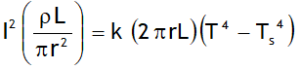
A fuse is a thin wire made up of an alloy of lead (75 %) & tin (25 %). Both its resistance and melting point are low. It is connected in series to the circuit in to protect the circuit from sudden strong currents by breaking the circuit. When the rate at which heat produced by the current becomes equals to the rate at which heat lost by radiation, the temperature of the wire further stops increasing. This stage is called steady state, then rate of heat supplied = Rate of heat lost i.e.

(a) For constant ρ, T & Ts we can write I2  ∝ r 3, L0

(b) As TS = 0 for vacuum & other terms are constants thus T 4 ∝ r – 3 or T  ∝ r – 3 / 4

^Finding net emf

Finding net emf

Here cells 1 & 2 are in parallel

^Instantaneous velocity

^Instantaneous velocity

Velocity a particular instant is called instantaneous.

At any point instantaneous velocity acts along the tangent at that point. Mathematically it is measured as the limiting value of the average velocity.

For motion along x – axis,   

Initial means, starting time i.e. t = 0

  1. For 1 D motion along x – axis we have,  i.e. instantaneous velocity is equal to slope of position time graph (x – t).

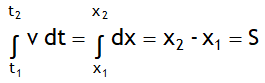
2. On separating the variables & integrating this relation can be rearranged as

i.e. area under x – t graph bounded with the time axis for a time interval is equal to displacement for that time interval.

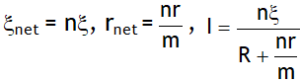
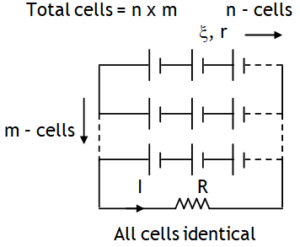
^Mixed grouping of identical cells

Mixed grouping of identical cells

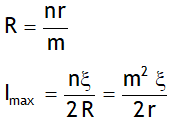
For maximum current

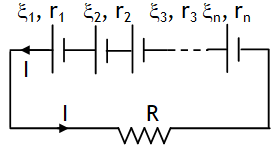
^n – cells in series

n – cells in series

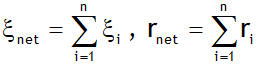
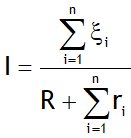
As all the cell supply current in same direction thus

^Power rating formula

Power rating formula

Resistance of a dc circuit element depends upon its rating in accordance with the relation,

Using above relation we can say

(a) A bulb of thin filament has more resistance.

(b) A low wattage bulb has more resistance (filament thinner) than a high wattage bulb of same rated voltage.

(c) Glow of a bulb ∝ H ∝ I2. In series a low wattage bulb glows more than a bulb of higher wattage while in parallel a high wattage bulb glows more than a bulb of lower wattage.

^Short circuiting a cell

Short circuiting a cell

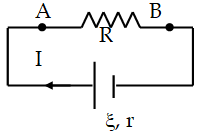
If resistance of the wire AB = R is zero & the switch S is closed, then the cell is said to be short circuited.

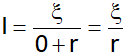
Then we can write & In fact this is the maximum value of current that can be supplied by a cell or a battery.
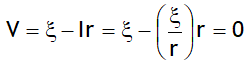
i.e. terminal potential difference of a short circuited cell is zero.

A cell with high emf & low internal resistance is most likely to be damaged due to short circuiting.

^Simple circuit

Simple circuit

1. Current delivered by cell:

2. Power dissipated by a load is PR = I2R

3. Power dissipated by a int. resistor is Pd, r = I2r

4. Power generated by a cell is

5. t.p.d. across cell & load is same & is

V = VA – VB = ξ – I r

error: Content is protected !!
Call 9872662552