Posts

^Electric current (I) & current density (J)

Electric current (I) & current density (J)

Electric current is the rate at which electric charge crosses a plane. i.e. mathematically,

Current per unit area is called current density, i.e. mathematically,

Electric current is scalar, while current density is vector. I & J are parallel to applied E – field.

^Kirchoff’s laws

Kirchoff’s laws

1st or junction rule: Σq = 0 at any isolated junction to conserve charge.

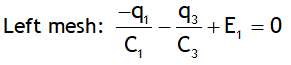
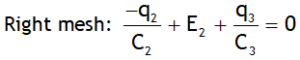
2nd or mesh rule: ΣV = 0 for any closed mesh to conserve energy.

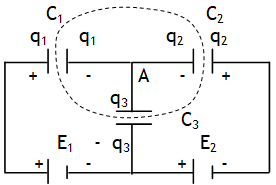
For shown circuit we can write

At jn. A: – q1 + q2 + q3 = 0

^Parallel grouping of capacitors

Parallel grouping of capacitors

1. Potential difference across all the components connected in parallel is same (i.e. V = constant)

2. Charge is among the various capacitors in accordance with q ∝ C i.e. a capacitor of greater capacitance will get more charge & vice versa.

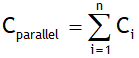
3. Effective capacitance is is given by,

^Spherical capacitor inner earthed

Spherical capacitor inner earthed

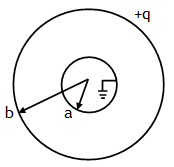
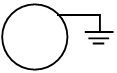
Suppose a neutral metal sphere radius a is placed concentrically inside a metal shell of radius b having surface charge +q.

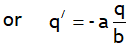
If inner sphere a is earthed then charge q/ appears on its surface from earth so that the potential of b becomes zero. i.e.,

Due to earthing & induction the final charge distribution will be

Due to this charge distribution electric field will be

1. E = 0 for r < a (i.e. inside a)

2. (radially outward) for a ≤  r ≤ b

3. (radially outward) for r > b

Due to earthing potential of a is zero & potential on b due to charge on outer surface of a & inner surface of b get cancelled & final potential on b is

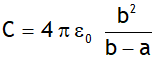
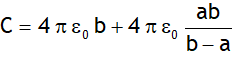
Using C = q/V, capacitance for this system is

The above relation can be expressed as

^Isolated spherical conductor

Isolated spherical conductor

1. Capacitance of an isolated spherical conductor of radius ‘a’ is Cearth = 4 πε0 a

2. As C ∝ a, thus big spheres have more capacitance than small spheres.

3. If the spherical isolated conductor is earthed, then entire charge leaks to earth, making its potential zero & thus C = ∞.

4. For earth capacitance is


^Type of physical quantities

^Type of physical quantities

Physical quantities can be categorized in following four types:

(a) Scalars    (b) Vectors   (c) Ratios  (d) Tensors

^Parallel plate capacitor

Parallel plate capacitor

If the plates X & Y have equal & opposite charges, then charge distribution on plates is as shown in the adjacent drawing. Usually for a parallel plate capacitor we consider this picture.

Let A is the area of each plate, then the charge density of face A, b, c & d are,
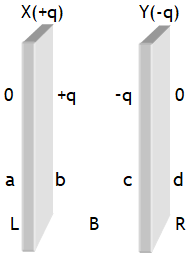
Elec. field on the left side (L) of plates, right side of plate (R) & between the plates due to the charge on face a, b, c & d is
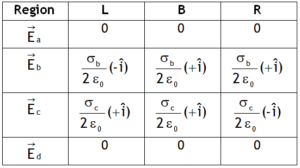
Outside the two plates (i.e. in the regions L & R) the electric field due to the charge on the faces a, b, c & d will cancel out, there will no net electric field outside the plates.

Net elec. field between the plates will be
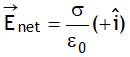
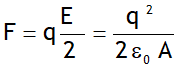
i.e. electric field due to a capacitor plates of equal & opposite charge is  zero outside it & inside is which is uniform both in magnitude & direction, (neglecting fringing). Due to this field there will be attractive force between plates, on each plate it will be,
Due to this electric field the potential difference between the plates X & Y separated by distance d is,

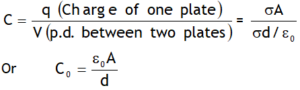
Capacitance of a PPC is
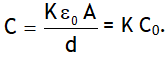
If the entire space is filled with a dielectric, then ε0 →  Kε0 & capacitance becomes
^Dimensionless Variables

^Dimensionless Variables

Are the physical quantities which have no dimensions but have variable values.

e.g. Angle, Strain, Specific gravity etc.

^Field due to charged conductors

Field due to charged conductors

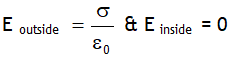
Under electrostatic conditions for a conductor of any shape,

^Point charge

Point charge

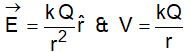
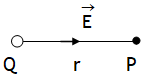
A body of almost no size is called a point body or discrete body i.e. a sphere of radius R → 0 is a point like body.  Both field & potential are not defined on a discrete charge, as r → 0 implies E & V → ∞. Outside the point charge field & potential are

Field of a point charge has following properties

1. radially outward if charge is positive & inwards if it is negative.

2. at finite distance around it, field is spherically symmetric & obeys inverse square law i.e. it is not uniform

3. at infinite distance from the it, field is zero

4. maxi. it the charge is placed in vacuum or air.

error: Content is protected !!
Call 9872662552