^Energy bands in solids

^Energy bands in solids

Energy levels of electrons in an isolated atom are well defined & discrete, however the valence energy levels get modified drastically when atoms interact to form the lattice. If N atoms interact, then total 8 N energy valence energy levels are available which split in two bands (called VB & CB) separated by energy gap (called Eg) as shown in the diagram.
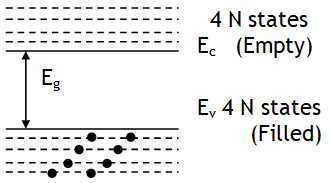
As E(Ge) < E(Si), thus Ge is preferred in making semi conducting devices.
^Semiconductors

^Semiconductors

Semiconductors (e.g. Si, Ge) belong to 14th group, thus have 4 valence electrons & hence from covalent bonds (temperature sensitive).  

^Absorption radiations

^Absorption radiations

Radiations are absorbed by the materials according to the relation:  I =  I0 e X  

Here    μ  = absorption coefficient

I = intensity after penetrating the material through ‘x’ thickness of material

I0 = intensity of the radiation before penetrating

Absorption coefficient is highest for Pb.

^Commonly used abbreviations

^Commonly used abbreviations

1. R: Roentgen

2. Rad:  Radiation absorbed dose

3. rem: Roentgen equivalent in man

4. RBE: Relative biological effectiveness

^Fission versus fusion

^Fission versus fusion

^Moderator

^Moderator

The neutrons produced in fission of 235U nuclei have average KE about 2 MeV. Such neutrons are called fast neutrons. These fast neutrons have more tendency to escape instead of triggering another fission reaction. Slow neutrons are more efficient in inducing fission in 92U235 nuclei than fast neutrons. By the use of a moderator, the fast neutrons are slowed to thermal velocities i.e. velocities » 2200 m/s & energies » 0.0235 eV, it is same as that of atoms and molecules at room temperatures, such slow moving neutrons are called thermal neutrons. Light target are better moderators. The commonly used moderator are water, heavy water (D2O), graphite and beryllium. About 25 collisions with deutrons (present in heavy water) or 100 collisions with carbon or beryllium are sufficient to slow down a neutron from 2 MeV to thermal energies.

A good moderator must have:

  1. low atomic weight
  2. should collide elastically with neutrons.
  3. should not absorb the neutrons


^Critical mass

^Critical mass

The minimum of Uranium needed to sustain chain reaction is called critical mass. It is 10 kg.

^Nuclear fuel

^Nuclear fuel

Fissionable material is called nuclear fuel. The isotopes like U-235, Th -232 and Pu 239 can be used as the reactor fuel. A certain mass of the fuel is taken in the form of rods, tightly sealed in Aluminium containers. The rods, separated by moderator are placed in the core of the reactor.

^Uranium enrichment

^Uranium enrichment

The 0.69% U235 is not sufficient to produce a self-sustaining critical chain reaction. To ensure high probability of chain reaction concentration of 235U has to be increased called enrichment. For reactors, the fuel must be enriched to 2.5-3.5%, U-235.

^Natural Uranium

^Natural Uranium

Found as uranium oxide (U2 O3)  which when purified has a rich yellow color and is called “yellowcake”. Uranium has three isotopes namely:

92U238 (99.3%), 92U235 (0.69%) & 92U234 (0.01%).

As the relative of abundance is highest for 92U238, it is called FERTILE. However fission is possible only with 92U235, thus is called FISSILE.

Chemical isotopes that can sustain a fission chain reaction are called nuclear fuels, and are said to be fissile.

error: Content is protected !!
Call 9872662552