*Harmonic progression
*Harmonic progression
If a, a + d, a + 2d, _ _ _ _ _ _ _ are in AP, then their reciprocals 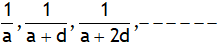 are in harmonic progression (HP).

*Harmonic progression
If a, a + d, a + 2d, _ _ _ _ _ _ _ are in AP, then their reciprocals are in harmonic progression (HP).
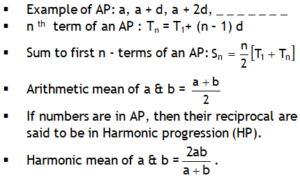
*Arithmetic progression
*Geometric progression
Example of GP: a, a r, ar2, _ _ _ _ _ _
n th term of an GP: Tn = T1r n – 1
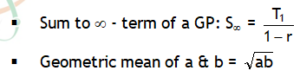
Sum to first n – term of a GP: Sn = 
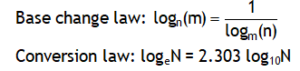
*Laws of log
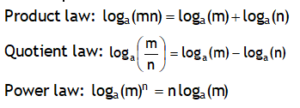
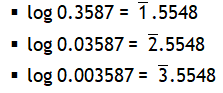
Examples
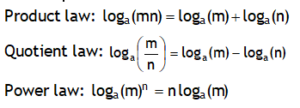
*Laws of log
*Characteristic & Mantisa
The integral part of the logarithm is called Characteristic and the decimal part called Mantisa. Characteristic may be positive, zero or negative. Negative characteristic is, it is represented it with a bar. The mantisa should be positive, if not, we try to make it by rearrangement as illustrated below
log10 N = – 4.5678,
= (- 4 -1) + (1- 0.5678)
= – 5 + (0.4322).
= .4322
*Logarithms
Let a is an arbitrary positive real number except 0. If ax = y, then logay = x
Conversely, the antilogarithm of x is the number y i.e. y = antilogax.
Here ax = y is called arbitrary exponential function and loga y = x is read is log of y to the base a is equal to x. If a = 10, log is called common & if it is e, then called natural.

*Logarithms
Let a is an arbitrary positive real number except 0. If ax = y, then logay = x
Conversely, the antilogarithm of x is the number y i.e. y = antilogax.
Here ax = y is called arbitrary exponential function and loga y = x is read is log of y to the base a is equal to x. If a = 10, log is called common & if it is e, then called natural.
*Binomial expansion
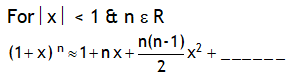
Neglecting the terms containing higher power of x we can write
(1 + x)n ≈ 1 + n x
*Determinants of 3rd order

 Call 9872662552