^Electric flux

Electric flux 

1. Electric flux (ΦE) linked with a surface (flat or curved) gives us an idea of the total number of electric field lines passing normally through that surface.

2. Electric flux is defined as the surface integral of the electric field inked with that surface i.e.

Here θ is the angle between electric field vector & area vector ( i.e. an area vector conventionally directed normally outwards to the area under consideration).

3. SI unit of flux: Weber (Wb)

4. CGS unit of flux: Maxwell (Mx)

5. Conversion: 1Wb = 10 8 Maxwell = 1Vm

6. Being dot product, electric flux is a scalar quantity.

7. Maximum value of flux = ± E S

8. Minimum value of flux = 0 (when θ = π/2)

9. If θ is acute flux is + ve & called leaving.

10. If θ is obtuse flux is – ve & called entering.
^For uniformly charged semi ring

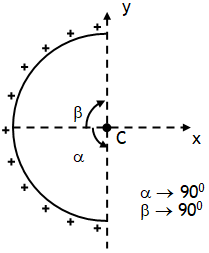
For uniformly charged semi ring

For a ring α & Β → 900 & E becomes


^For infinite line charge

For infinite line charge

Both α & β will approach to 900 & E becomes

^Finite line charge

Finite line charge

The above result is valid even if the wire is bent to form an arc as shown.

^Uniformly charged ring of radius R

Uniformly charged ring of radius R

1. Charge on a circular ring of radius R & uniform  linear charge density λ is, Q = λ 2 πR

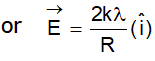
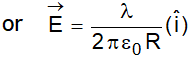
2. Electric field on axis at P,

3. Electric field at centre C = 0

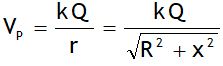
4.

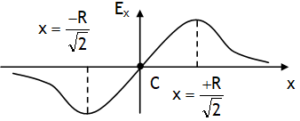
5. Variation of elec. field vector with distance

6.

7.


*Average value of a quantity

*Average value of a quantity

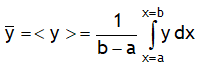
If a quantity y varies with x, then its average value in the interval x e [a, b] is defined as,

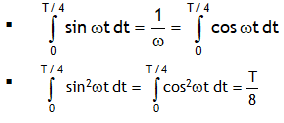
Average value for one complete cycle

  1. of sinθ & cosθ is zero.
  2. of sin2 θ & cos2θ is half.

^Electric dipole in uniform electric field

Electric dipole in uniform electric field

Consider an electric dipole in a region of uniform electric field

1. Net force on the dipole for any position is zero.

2. Torque acting on the dipole is .

3. Torque acts except for the positions when the dipole moment vector & electric field vector are collinear.

4. Total work done by us in rotating the dipole in a uniform electric field is from angle θ1 to θ2 is

W = pE (cos θ1 – cos θ2)

5. The potential energy of an electric dipole placed in a uniform electric field is

6. A dipole placed in a non uniform electric field experiences both force and torque.

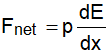
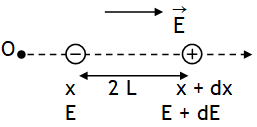
7. Force on a dipole placed in shown non uniform electric field is

^Standard integrals

^Standard integrals


*Geometrical Meaning of integration

*Geometrical Meaning of integration

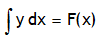
is called Integral or primitive of y w.r.t. x or anti-differentiation.
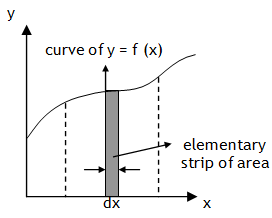
Here, ydx is area of elementary rectangular strip of thickness dx.

Thus gives the total area bounded by the all the elementary strips of the curve represented by the function

y = f (x) with the x-axis between the limits x = a to x = b. As convention upward areas are taken as positive and downward area negative.

^Electric dipole

Electric dipole

1. On axial line:

2. On eq. line:

3. At center:

4. Following diagram shows variation of electric field with distance on axial line of dipole.

5.

6. For short dipole

(a) On axial line:

(b) On equatorial line:

(c) Any point: directed at with Ex.

(d)

error: Content is protected !!
Call 9872662552