^Advantages of SI system

^Advantages of SI system

Following are the advantages of SI system:

Coherent: SI system of units is coherent. i.e. any unit can be derived by simply dividing & multiplying from any seven fundamental units & two basic  units.

Rational: For one physical quantity only one unit is used.

Absolute: Use of ‘g’ is avoided.

Metric: The use of multiples & submultiples is allowed. Accepted universally: As SI system can be easily reproduced, compared & time invariant.
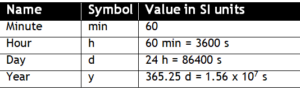
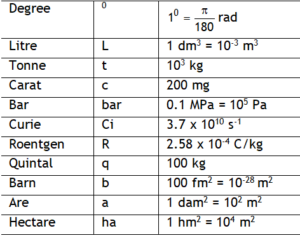
*Value in S.I units

*Value in S.I units


*Some SI Derived units with special names

*Some SI Derived units with special names

Quantity SI unit Symbol
Force newton N
Work joule J
Pressure, Stress pascal Pa
watt W
Angle radian rad
Frequency hertz Hz
Viscosity poiseuille Pl
Torque newton meter Nm
Electric charge coulomb C
Electrical resistance ohm W
Voltage volt V
Flux (Elec. or mag) weber Wb
Inductance henry H
Capacitance farad F
Magnetic field tesla T
Illuminance lux Lx
Luminous flux Lumen lm
Illuminance lux lx
Activity (radioactive) Becquerel Bq
Absorbed dose index Gray Gy

*One steradian

*One steradian

One steradian (sr)is the solid angle subtended at the centre of a sphere by that surface of the sphere which is equal in area to square of the radius of the sphere.


^One radian

^One radian

One radian (rad) is the angle subtended at the centre of a   circle by an arc of length equal to the radius of circle.

*The Seven Fundamental Quantities

*The Seven Fundamental Quantities


*Fundamental quantities

*Fundamental quantities

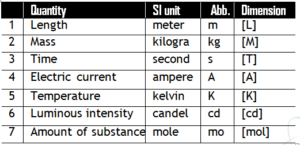
Seven physical quantities have been chosen as fundamental or base quantities these are length, mass, time, electric current, thermodynamic temperature, amount of substance, and luminous intensity. Units of base quantities are called base units or fundamental units. Fundamental or base quantities are also known as the seven dimensions of the world.

^Numerical & unit

^Numerical & unit

The magnitude of a quantity doesn’t change with the change of unit. i.e. numerical & unit of a physical quantity are inversely proportional.


^Gaussian surface

Gaussian surface

  1. To find electric field due to a charge configuration using Gauss’s law we draw an imaginary closed surface around that charged distribution.
  2. Gaussian surfaces are normal to electric lines of & symmetric to the charge enclosed such that electric field at every point of the Gaussian surface due to that charged distribution is same.
  3. Gaussian surfaces are spherical for point charges or spherical distribution of charges & cylindrical for linear and planar distribution of charge.
  4. Only those charges which lie inside the Gaussian surface are considered & that located outside have no contribution in the flux.
  5. Discrete charges on the surface of the -Gaussian surface are not considered (as electric field at the location of a discrete charge is not defined) but continuous charges can be considered.

^Gauss’s law

Gauss’s law

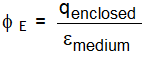
1. According to Gauss’s law the electric flux  through any arbitrary closed surface in a medium is equal to the total charge enclosed by the that surface divided by the permittivity of that medium. i.e.

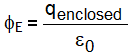
2. If medium is air or vacuum, then

3. Gauss’s law is based on the inverse square dependence on distance contained in the Coulomb’s law. Any violation of Gauss’s law will indicate departure from the inverse square law.

4. Using Gauss law we can say no. of electric line of force originating or terminating on a charge of q coulomb is equal to q/ε0.

error: Content is protected !!
Call 9872662552