^Isolated spherical conductor

Isolated spherical conductor

1. Capacitance of an isolated spherical conductor of radius ‘a’ is Cearth = 4 πε0 a

2. As C ∝ a, thus big spheres have more capacitance than small spheres.

3. If the spherical isolated conductor is earthed, then entire charge leaks to earth, making its potential zero & thus C = ∞.
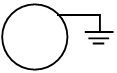
4. For earth capacitance is

 

^Light year (ly)

^Light year (ly)

It is the distance travelled by light in vacuum (with a speed of 3 x 10⁸ m/s) in one year

(i.e., 365 x 24 x 60 x 60 s).

1 ly = 3 x 108 x (365 x 24 x 60 x 60) » 9.5 x 10¹⁵ m

^Astronomical Unit (AU)

^Astronomical Unit (AU)

It is the mean distance of the Earth from the Sun.

1 AU = 1.496 x 10¹¹ m » 1.5 x 10¹¹ m


^PPC with a metal slab in plates

PPC with a metal slab in plates

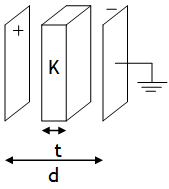
If a metal slab (dielectric constant K = ∞), thickness t < d is placed between the plates of a PPC, then due to the electric field between the capacitor plates the dielectric gets polarized & an electric equal to E0 is induced in it, as a consequence net electric field in dielectric is found to be zero i.e. Enet = 0.
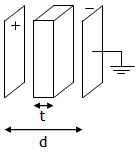
Due to this field electric field net potential difference across the capacitor plates becomes

Using C = q/V, capacitance of capacitor becomes

If the conducting slab occupies the entire space available between the plates of capacitor i.e. when t =d & K = ∞, then C = ∞

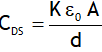
Comparing (a), (b) & (c) we can say

CDS > CCS > Co

^What is a Tensor? 

^What is a Tensor?       

A physical quantities which have no specified direction but different values in different directions are called tensors.

Stress, Strain, Density, dielectric constant, refractive index, electrical conductivity, electrical resistivity, moment of inertia etc are tensors. These quantities are taken as tensors at microscopic level & scalars macroscopically.

Following practical units of length are commonly used:

^What is a ratio?

^What is a ratio?         

If a physical quantity can be completely described just by knowing its only numerical value, no unit & direction is required, then it is called ratio.

e.g. Strain, Poisson’s ratio, refractive index, relative density, relative permittivity, relative permeability, fine structure constant etc.

^What is a vector?

^What is a vector?

If both magnitude and direction are required to completely described a physical quantity, then it is called a vector. A vector quantity is represented by putting on arrow above it or by bold letter e.g. it Q is vector then we represent it as  or Q. if a quantity can have any direction it is called polar. If its direction is along axis only then called axial.

^PPC with a dielectric slab in plates

PPC with a dielectric slab in plates

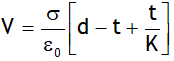
If a dielectric slab of dielectric constant K, thickness t < d is placed between the plates of a PPC then due to the electric field between the capacitor plates the dielectric gets polarized & an electric is induced in it, as a consequence net electric field in dielectric is found to be .
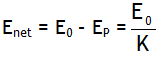
Due to this field electric field net potential difference across the capacitor plates becomes .

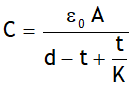
Using C = q/V, capacitance of capacitor becomes .

1. If the entire space between the capacitor plates is occupied by air or vacuum, then .       [using K = 1 and t = 0]

2. If the entire space between the capacitor plates is occupied by dielectric, then            [using t = d]

*What is a scalar?

*What is a scalar?

If a physical quantity can be completely described by telling its magnitude only and direction is meaningless for it, then it is called a scalar.

^Type of physical quantities

^Type of physical quantities

Physical quantities can be categorized in following four types:

(a) Scalars    (b) Vectors   (c) Ratios  (d) Tensors

error: Content is protected !!
Call 9872662552