^Series dielectrics in a capacitor

Series dielectrics in a capacitor

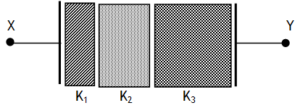
If three dielectric slabs of thickness t1, t2 & t3, dielectric constants K1, K2 & K3 are placed between the plates of a parallel plate capacitor as shown, then the combination behaves as different dielectrics dividing the spacing are considered as capacitors connected in series.

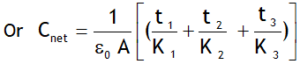
Capacitance of this is given by

^Energy (potential) stored in a capacitor

Energy (potential) stored in a capacitor

A charged capacitor of any shape or size stores energy (potential) in the form of electrostatic electric field, it is given by

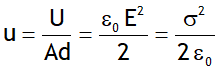
Energy per unit volume is called energy density, it is Electric energy density,

^Series grouping of capacitors

Series grouping of capacitors

1. Charge on all the components connected in series is same (i.e. q = constant).

2. Potential difference is divided among the various capacitors in accordance with  e. a capacitor of smaller capacitance will get more potential difference & vice versa.

3. Effective capacitance is given by,

^Parallel grouping of capacitors

Parallel grouping of capacitors

1. Potential difference across all the components connected in parallel is same (i.e. V = constant)

2. Charge is among the various capacitors in accordance with q ∝ C i.e. a capacitor of greater capacitance will get more charge & vice versa.

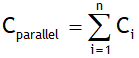
3. Effective capacitance is is given by,

^Conduction

Conduction

Suppose two charged metal spheres of radii R1 & R2 of different potentials are joined by a metal wire, then charge flows from conductor at higher potential to that at lower potential till both acquire the same potential ‘V’ called common potential. This stage is called steady state & is achieved almost immediately after joining the charged conductors.

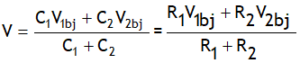
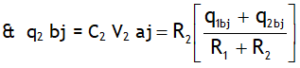
1. Common potential at steady state can be calculated using charge conservation i.e. total charge of conductor 1 & 2 before joining

& after joining is same i.e.

q1bj + q2bj = C1 V + C2 V

Or   V = V1 aj = V2 aj

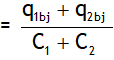
The above relation can be expressed as

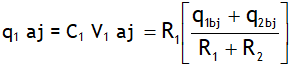
2. Charge on each conductor after joining is

As q = C V & C ∝ R, thus bigger sphere gets more charge after conduction.

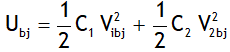
3. Total energy of the system before joining is

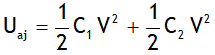
Total energy of the system after joining is

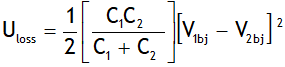
Uaj is found to be smaller than Ubj. The system looses some of its energy in the form of heat, which is given by

^Spherical capacitor inner earthed

Spherical capacitor inner earthed

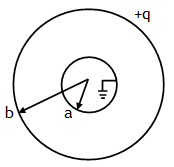
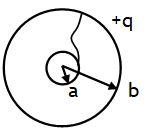
Suppose a neutral metal sphere radius a is placed concentrically inside a metal shell of radius b having surface charge +q.

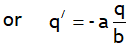
If inner sphere a is earthed then charge q/ appears on its surface from earth so that the potential of b becomes zero. i.e.,

Due to earthing & induction the final charge distribution will be

Due to this charge distribution electric field will be

1. E = 0 for r < a (i.e. inside a)

2. (radially outward) for a ≤  r ≤ b

3. (radially outward) for r > b

Due to earthing potential of a is zero & potential on b due to charge on outer surface of a & inner surface of b get cancelled & final potential on b is

Using C = q/V, capacitance for this system is

The above relation can be expressed as

^Spherical capacitor outer earthed

Spherical capacitor outer earthed

Suppose a metal sphere of charge +q & radius a is placed concentrically inside a metal shell of radius b. The charge of a induces charge – q on inner surface & +q on its outer surface of shell b. If shell b is earthed then its +q leaks to earth so that the potential of b becomes zero. Due to earthing & induction the final charge distribution will be
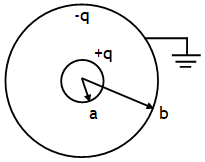
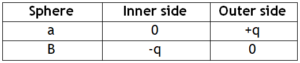
Due to this charge distribution electric field will be

1. E = 0 for r < a (i.e. inside a)

2. (radially outward) for a ≤  r ≤ b

3. E = 0 for r > b (i.e. outside b)

Due to this charge distribution the potential on a & b will be
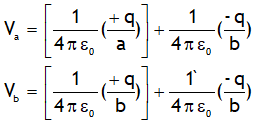
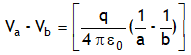
On subtracting above relations we get the potential difference between the a & b, it is
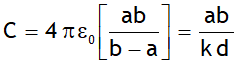
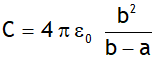
Using C = q/V, capacitance for this system becomes
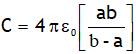
From above result it is clear

1. Let b – a = d is the distance between two spheres & , then we can write
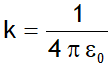
2. in order to have maximum  capacitance the radii of two spheres should be as high as possible & separation between them should as small as possible.

3. Suppose the shell b is situated ∞,  then we can say sphere a is isolated, then its using b = ∞,  we get C = 4 π ε0 a

4. If a & b are very large such that b – a = d & , then .

5. As , thus we can say that the capacitance of a spherical capacitor is always greater than the capacitance of an isolated sphere.

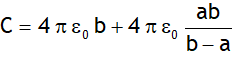
6. If the outer sphere is not earthed & inner sphere is connected to outer by a metallic wire, then entire charge moves outer & capacitance becomes C = 4 π ε0 b.
*Some Practical Units of Mass

*Some Practical Units of Mass

  • 1 slug = 14.57 kg
  • 1 quintal(q) = 100 kg
  • 1 tonne (t) = 1000 kg
  • Chandrasekhar Limit (CSL)= 1.4 solar masses

= 1.4 x (2 x 1030 kg)

= 2.8 x 1030 kg

  • 1 unified atomic mass unit (u)= 1.66 x 10 -27 kg
  • 1 carat (c) * = 200 mg

*carat is also a measure of purity of gold, pure gold being 24 carat.

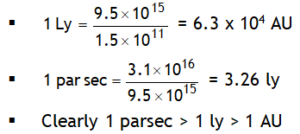
^Relations between AU, Ly and parsec

^Relations between AU, Ly and parsec

^Parsec

^Parsec

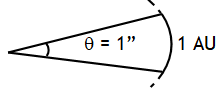
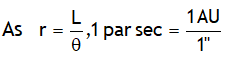
Parsec is an abbreviation of parallatic second. One parsec is the distance at which an arc of length one astronomical unit subtends an angle of 1 s,     

(by definition when L = 1 AU, q = 1 “, r = 1 parsec)

error: Content is protected !!
Call 9872662552