^Series combination of resistors

Series combination of resistors

The current across each circuit element is same, but potential difference is different & proportional to resistance of that part.

i.e. I = I1 = I2 = I3 & V1 = IR1, V2 = IR2, V3 = IR3 & R series  = R1 + R2 + R3

^Zero α for Nichrome, constantan & Manganin

Zero α for Nichrome, constantan & Manganin

i.e. there is appreciably no change (or very slight change) in R with temperature.

1. Constantan (or Eureka) ≡ Cu 60% & Ni 40%

2. Manganin ≡ Cu 84%, Mn 12% & Ni 4%

3. Nichrome ≡ Ni 67.5%, Cr 15%, Fe 16% & Mn 1.5%

^- ve α for electrolytes

– ve α for electrolytes 

Cause of decrease in R with increase in temp. for electrolytes is decrease in viscosity.

^- ve α for semiconductors

– ve α for semiconductors

On heating semiconductors the number density of free electrons increases & τ decreases. But the effect of increase in ‘n’ is stronger than decrease in relaxation time (τ). Hence net effect is increase in ‘n’ which decreases resistance.

^Error in exponential form

^Error in exponential form

Differentiating both sides we can write

The maximum value of fractional error will be

^+ ve α for metals & alloys

+ ve α for metals & alloys

With the increase in temperature of metals & alloys thermal agitation increases & hence the rate of collision increases. As a result the average time t between the successive collision decreases & hence the drift speed decreases, consequently the resistivity of metals increases.

^Temperature variation of resistance

Temperature variation of resistance

On heating a material its resistivity changes, which changes the electrical resistance of the material. The electrical resistivity at temperature T can be calculated by using relation: ρ= ρ0 (1+ αT)

^Resistance of a wire on stretching

Resistance of a wire on stretching

(a) increases n2 times original resistance if length is increased n times.

(b) decreases n4 times if the radius of a wire is increased n times.

Provided mass, density & resitivity wire are kept fixed.

^Resistance of various geometries

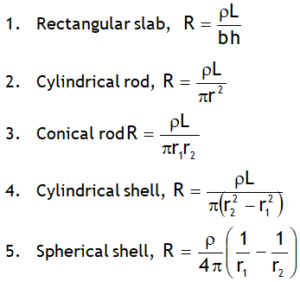
Resistance of various geometries

Relations 1 to 4 are across length & relations 5 is for radial flow.

Above results are valid for uniform resistivity ρ only.

^Electric resistance

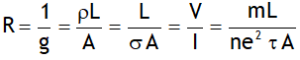
Electric resistance

Depends upon the nature of material, shape & size, physical state like temperature, pressure, type & extent of impurity etc. of conductor. However r depends upon all above factors except on shape & size.

error: Content is protected !!
Call 9872662552