^Simple circuit

Simple circuit

1. Current delivered by cell:

2. Power dissipated by a load is PR = I2R

3. Power dissipated by a int. resistor is Pd, r = I2r

4. Power generated by a cell is

5. t.p.d. across cell & load is same & is

V = VA – VB = ξ – I r

^Selection of cells

Selection of cells

  1. Leclanche cell for intermittent supply of current.
  2. Daniel cell for constant EMF source.
  3. Lead accumulator for strong current ~ 100 A due to its low r.
  4. Lead accumulator also called acid cell for highest EMF (= 2.05 V) & minimum internal resistance (≈0.01 Ω).
  5. Dry cell for weak current ~ 10 mA.

^Secondary cells

Secondary cells

Secondary cells or accumulators are those which can be recharged. e.g. lead accumulator & alkali cell. Due to smaller internal resistance a secondary cell gives more current than a primary.

^Primary cells

Primary cells

Primary cells are those which can’t be recharged.

e.g. Simple voltaic cell (ξ = 1.08 V), Daniel cell (ξ = 1.12 V), Leclanche cell (ξ = 1.45 V) & Dry cell etc (ξ = 1.50 V).

^Standard cell

Standard cell

A cell is said to be Standard if its EMF is precisely defined. e.g. Weston – Cadmium cell with an EMF

E = 1.0183 V at 20 0 C.


^Internal resistance

Internal resistance

Is the obstruction to the free motion of positive & negative ions of the electrolyte by the viscosity of the electrolyte used in the cell. It is zero for an ideal cell. For a freshly prepared cell the internal resistance is very small & its value increases as the cell is put to more & more use. The internal resistance of a cell varies directly with distance of the electrodes concentration of electrolyte polarisation of the cell & varies inversely varies with the area of electrodes. Both emf & internal resistance are different for different cells & depends on the nature of electrolyte & nature of rods used.

^Significant figures

^Significant figures

All accurately known digits plus the first uncertain digit of a measurement is called significant digits or significant figures. e.g. if in a measurement, mass of a body lies between 5.6 kg & 5.7 kg & we estimate it as 5.62 kg then the first two digits 5 & 6 are certain while the third digit 2 is approximately known we can say there are 3 significant figures.

Following are the rules for counting significant figures

Rule 1: All non zero digits are significant.

Rule 2: All zeros occuring between two non zero digits are significant.

Rule 3: The digit zero (underlined) conventionally put on the left of a decimal for a number less than one is never significant. All zeros to the right the decimal point are not significant.

Rule 4: The terminal or trailing zero(s) in a number without a decimal point are not significant.

Rule 5: The trailing zero(s) in a number with a decimal point are significant.

Rule 6: The powers of ten are not significant.

Rule 7: No. of significant figures remains unchanged on changing the units of measurement, zeroes appearing in the base number in the scientific notation are significant.

Example NSD Using rule
4567 Four 1
450067 Six 2
0.004567 Four 3
456700 Four 4
0.00456700 Six 5
4.5 x 10 – 6 Two 6
5.300 x 10 6 mm Four 7

^EMf of a cell

EMf of a cell

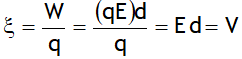
It is defined as the work done by the cell force in moving a unit positive charge inside the cell from the negative to the positive terminal against the potential difference between the cell terminals when no current is drawn from it. i.e. mathematically

EMF of a cell depends upon Nature & concentration of the electrolyte, temperature of the electrolyte, nature of the electrodes. But is independent of size of electrodes, Distance between the electrodes, area of electrodes immersed in the electrolyte & quantity of electrolyte.

^Electric cell

Electric cell

It neither creates nor destroys charge, whereas it just maintains the potential difference & organized flow of charge by supplying energy.

^Parallel combination of resistors

Parallel combination of resistors

The voltage is same across each circuit element is same but current is different & is inversely proportional to resistance of that part.

V = V1 = V2 = V3 = I1R1 = I2R2 = I3R3

&

Fact the maximum number of combination one can have, using all n – resistors at a time is:

(a)  2 (n – 1)      [For n – identical resistors

(b) 2n                    For n – different resistors

error: Content is protected !!
Call 9872662552