^Least count, accuracy & significant digits

^Least count, accuracy & significant digits

Suppose a rod is measured by a metre stick, and is estimated to lie between 1.6 and 1.8 m, then its length can be written as 1.7 m. It contains two significant digits, of which we are perfectly sure of the position of 1, but slightly doubtful regarding the position of 7.

Now, suppose the same rod is measured by a metre scale graduated to centimetres and is estimated to lie between 173.2 cm & 173.4 cm then its length can be written as 173.3 cm or 1.733 m. Now, the number of significant digits are four namely, 1, 7, 3 and 3 and hence there is an increment in the accuracy of the value. Smaller the least count of a measuring instrument, more will be its accuracy in measurement and accordingly more will be the number of significant digits.
^Accuracy & Precision

^Accuracy & Precision

The accuracy of a measurement is a measure of how close the measured value is to the true value of the quantity. Precision tells us to what resolution or limit the quantity is measured.

For example, suppose the true value of a certain length is near 3.678 cm. In one experiment, using a measuring instrument of resolution 0.1 cm, the measured value is found to be 3.5 cm, while in another experiment using a measuring device of greater resolution, say 0.01 cm, the length is determined to be 3.38 cm. The first measurement has more accuracy (because it is closer

to the true value) but less precision (its resolution is only 0.1 cm), while the second measurement is less accurate but more precise.

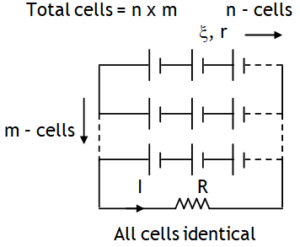
^Mixed grouping of identical cells

Mixed grouping of identical cells

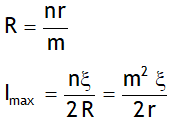
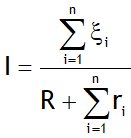
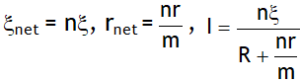
For maximum current

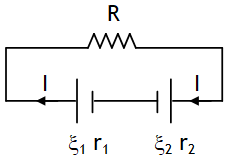
^Two series cells in oppostions

Two series cells in oppostions

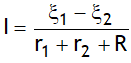
As the two cells are opposing thus

ξnet =ξ1 – ξ2 , rnet = r1 + r2

V1 = ξ1 – Ir1, V2 = ξ2 + I r2

^Two cells in parallel

Two cells in parallel

I = I1 + I2

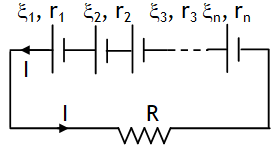
^n – cells in series

n – cells in series

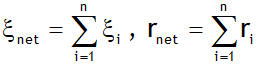
As all the cell supply current in same direction thus

^Power transferred theorem

Power transferred theorem

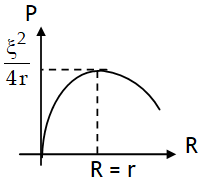
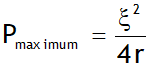
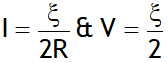
The power transferred by a cell to the load is maximum when R = r & given by

Also then

^Power delivered

Power delivered

Power delivered by a dc circuit element can be calculated using the relation

Using above relation we can say

1. The rate of heat generated in a wire is doubled when both the radius & length of the wire is doubled.

2. For constant voltage, the time taken to boil water by a heater directly varies with its resistance. i.e. t ∝ R.

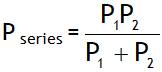
3. Equivalent power of two bulbs of same voltage rating connected to a supply of voltage equal to voltage rating of either is

(i)        (ii) Pparallel = P1 + P2

^Power rating formula

Power rating formula

Resistance of a dc circuit element depends upon its rating in accordance with the relation,

Using above relation we can say

(a) A bulb of thin filament has more resistance.

(b) A low wattage bulb has more resistance (filament thinner) than a high wattage bulb of same rated voltage.

(c) Glow of a bulb ∝ H ∝ I2. In series a low wattage bulb glows more than a bulb of higher wattage while in parallel a high wattage bulb glows more than a bulb of lower wattage.

^Short circuiting a cell

Short circuiting a cell

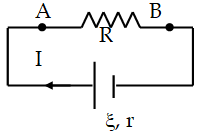
If resistance of the wire AB = R is zero & the switch S is closed, then the cell is said to be short circuited.

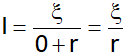
Then we can write & In fact this is the maximum value of current that can be supplied by a cell or a battery.
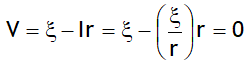
i.e. terminal potential difference of a short circuited cell is zero.

A cell with high emf & low internal resistance is most likely to be damaged due to short circuiting.

error: Content is protected !!
Call 9872662552