^Displacement versus distance

^Displacement versus distance

  Displacement Distance
Between two points Length of shortest path Length of actual path
Sign     +ve or –ve +ve always
Can be zero Yes No
Direction Initial to final Meaningless
SI unit meters meters
Are equal Only for motion along straight line with no reversal

^Displacement

^Displacement

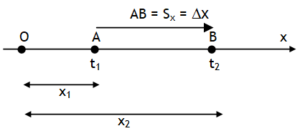
Suppose a body is moving along a straight line. Let the straight line is along x – axis. Let at a time t1 it was situated at point A at a distance x1 from a fixed point O. Let it moves & at time t2 reaches point B situated at a distance x2 from O.

Here the distance AB is called displacement of the body along x axis (Sx) in the time interval t2 – t1 (= Dt). In terms of position coordinates it can be expressed as

Displacement, AB = OB – OA = x2 – x1 or Δx.

i.e. for motion along displacement is equal to the change in position coordinates along that line.

^Position of an arbitrary point P at any time is described using cartesian coordinates i.e. P (x,y, z).

Position

^Position of an arbitrary point P at any time is described using cartesian coordinates i.e. P (x,y, z).

For 1 D motion along x axis, y & z coordinates are zero, where as x coordinate may be + ve or – ve.

1, 2 & 3 – D motion

If coordinate required to specify the position of a moving object at any instant are;

  1. then motion is called 1 D e.g. moving along a straight line without turning.
  2. then motion is called 2 D e.g. an object moving along a circle.
  3. then motion is called 3 D e.g. random motion of gas particles

^Point object

^Point object

An object is said to be a point object if it covers distance much greater than its size.

^Kinematics

^Kinematics

Kinematics is a branch of physics which deals with the study of motion of the objects without considering their cause. In kinematics we ignore the size of body & assume it to be a point particle.

^Description of motion 

^Description of motion 

Three parameters used to describe the motion of a body are; position, velocity & acceleration. Usually a reference point plus a clock is used to describe motion of an object.

^Dynamics is a branch of physics which deals with the study of motion of the objects considering their cause also.

Dynamics

^Dynamics is a branch of physics which deals with the study of motion of the objects considering their cause also.

^Statics is a branch of physics which deals with the conditions of objects at rest (i.e. static equilibrium).

Statics

^Statics is a branch of physics which deals with the conditions of objects at rest (i.e. static equilibrium).

^Mechanics

^Mechanics

It is a branch of physics which deals with the conditions of rest or motion of the objects.

It is divided in three parts

1. Statics         2. Kinematics         3. Dynamics

^Rest & motion

^Rest & motion

If position of body changes w.r.t. surroundings with the time then it is said to be moving otherwise at rest. Rest & motion are relative. A person sitting in a moving vehicle is at rest w.r.t. other persons in sitting same vehicle while is in motion w.r.t. other persons standing on road. If the position of a body doesn’t change with respect to all objects in the universe, then it is said to be in absolute rest. Absolute rest is impossible. If the position of a body doesn’t change with respect to one or more things in the universe, then it is said to be in relative rest. Relative rest is possible.

error: Content is protected !!
Call 9872662552