^Sources of error

Sources of error

  1. The jockey should not be rubbed on the wire, as this resistance of wire will not remain uniform.
  2. Current should not be allowed to flow in the wire for a long time as this by producing heat will change the resistance of the wire.
  3. The value of resistor R is so selected that the null point is in the middle of the wire. Actually by doing so the error in the measurement is minimized. Also then all the four resistors are of the same order.
^Wheatstone bridge

Wheatstone bridge

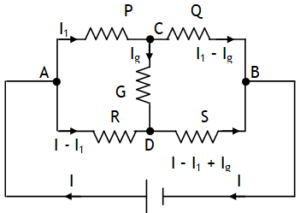
It is the quadrilateral arrangement of four resistors P, Q, R & S connected to a cell & galvanometer G as shown. Here P & Q are called ratio arms, R known arm & S unknown arm.

1. If , then VC = VD & the bridge is said to be balanced i.e. the potential difference across the arm CD is zero, consequently no the current through the arm CD & thus arm CD can be removed. Also the position of cell & galvanometer can be interchanged.

2. If , then VC ≠ VD & bridge is said to be in the unbalanced state. If  then current flows from up & if  then current flows down.

3. Wheatstone bridge is said to be sensitive if all the four resistances are of the same order i.e. when the current in the four branches is of the same order. In this case error associated with the measurement of X is mini.

^Voltmeter

Voltmeter

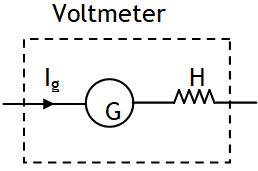
(a) Constructed by connecting a high value resistor (H) in series to a galvanometer.

(b) V = I ( G + H )

(c) RV = G + H → ∝ for ideal

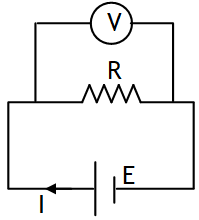
(d) Used in parallel across the resistor whose voltage is to be measured.

^Ammeter

Ammeter

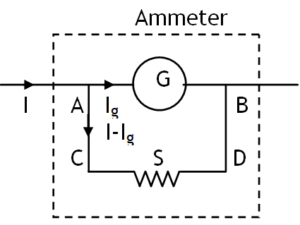
(a) Constructed by connecting small resistance called shunt (S) in parallel to a galvanometer.

(b) Ig G = (I – Ig) S

(c)

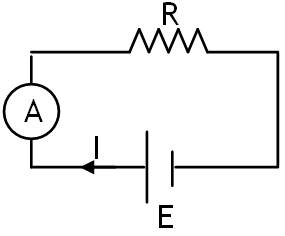
(d) Used in series with the resistor whose current is to be measured.

^Galvanometer

Galvanometer

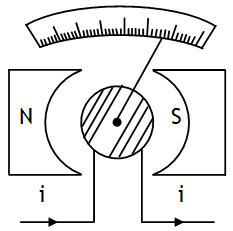
A current carrying coil placed in a magnetic field experiences a torque & deflects.

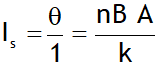
This deflection is calibrated to measure current flowing in it. Used to detect & measure only small currents of the order of microamperes. Current sensitivity (Is): It is defined as the deflection produced for a unit current. i.e. . Is can be increased by increasing B or by decreasing k (by taking quartz or phosphorous bronze). Reciprocal of current sensitivity is called ‘figure of merit’. As we have discussed that a galvanometer fails to measure currents I > Ig. In order to measure currents I > Ig we use an Ammeter.
^Fuse

Fuse

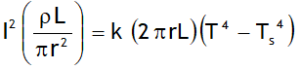
A fuse is a thin wire made up of an alloy of lead (75 %) & tin (25 %). Both its resistance and melting point are low. It is connected in series to the circuit in to protect the circuit from sudden strong currents by breaking the circuit. When the rate at which heat produced by the current becomes equals to the rate at which heat lost by radiation, the temperature of the wire further stops increasing. This stage is called steady state, then rate of heat supplied = Rate of heat lost i.e.

(a) For constant ρ, T & Ts we can write I2  ∝ r 3, L0

(b) As TS = 0 for vacuum & other terms are constants thus T 4 ∝ r – 3 or T  ∝ r – 3 / 4

^CR circuits

With switch S thrown towards A, capacitor undergoes charging in accordance with

With switch S thrown towards B, capacitor undergoes discharging in accordance with

Here CR = t is called capacitive time constant.

Following table is useful to solve problems based on exponential functions.

^Finding net emf

Finding net emf

Here cells 1 & 2 are in parallel

^Instantaneous velocity

^Instantaneous velocity

Velocity a particular instant is called instantaneous.

At any point instantaneous velocity acts along the tangent at that point. Mathematically it is measured as the limiting value of the average velocity.

For motion along x – axis,   

Initial means, starting time i.e. t = 0

  1. For 1 D motion along x – axis we have,  i.e. instantaneous velocity is equal to slope of position time graph (x – t).

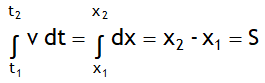
2. On separating the variables & integrating this relation can be rearranged as

i.e. area under x – t graph bounded with the time axis for a time interval is equal to displacement for that time interval.

^Average velocity

^Average velocity

Velocity between two instants is called average. Mathematically it is measured as the displacement covered per unit time spent. It is also a vector quantity directed in the direction of displacement.

For motion along x – axis,   

error: Content is protected !!
Call 9872662552