^At centre of arc
At centre of arc
Magnetic field at centre of arc is 
Use θ in radians.
Contribution of straight parts at C is zero.
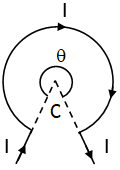

At centre of arc
Magnetic field at centre of arc is
Use θ in radians.
Contribution of straight parts at C is zero.
Circular ring
Magnetic field on the axis of a circular ring

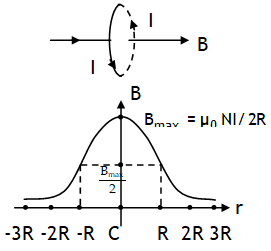
To find field at C use r = R & r = x for far away point.
Magnetic field is maximum at centre of ring, it is

Straight thin finite conductor
Magnetic field at point P around a straight thin finite conductor is 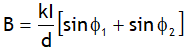

On a thin conductor magnetic field is not defined.

Arbitrary current carrying conductor
Magnetic field at point P around a conductor of arbitrary shape
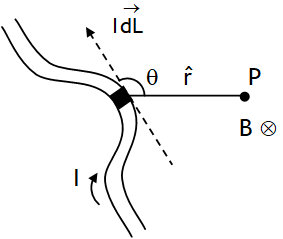
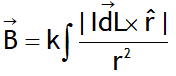
Here  is called current element.
Moving point charge
Magnetic field at point P for a point charge ‘+q’ moving with velocity  is
is 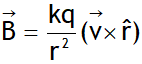
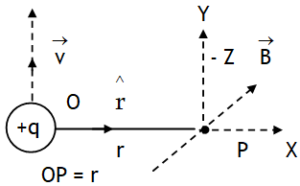
In any arbitrary volume of conductor net negative & positive charge is equal, thus net charge enclosed for any section is zero, hence electric field outside a current carrying conductor is zero. Also if an observer moves along the free electrons of a current carrying conductor with a velocity equal to drift velocity of free electrons, then the magnetic field experienced at the observer location will be due to relative velocity of positive ions of conductor w.r.t. observer.
Facts
 → Induced magnetic field or magnetic induction vector or magnetic flux density.: weber/meter2 or tesla (T)
 = 10 – 7 A– 1 Tm
Biot–savart’s law
The magnitude of the magnetic field produced depends upon
Direction of magnetic field due to both straight as well as curved conductor can be calculated by right hand stretched thumb rule. For straight conductor thumb point current & curl of fingers point magnetic lines while in a curved conductor reverse of it. On reversing the direction of current the direction of magnetic field produced is reversed.
Oersted observation
Oersted (1820) was the first to discover magnetic field associated with a current carrying conductor. He found that if a wire carrying a current from South to North is placed Over a magnetic needle, then the north pole the needle gets deflected towards the West. This is named as SNOW rule.
^Vector addition law
The essential condition for the addition of the two vectors that they should of the same physical nature e.g. force can be added in to force, velocity can be added in to velocity only.
*Describing a vector
A vector can be expressed as infinite no. of components in 2D or 3 D, however generally a vector is expressed as the resolution of three mutually perpendicular components
a, b & c along x, y & z axis respectively.
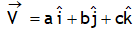
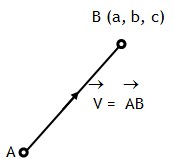
Here (a, b, c) are also called direction ratios of  .
.
Length of a vector is called its magnitude .. Magnitude of is described as, 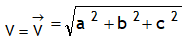
Let makes angle θx, θy & θz with the x, y & z axis respectively. cos of these angels are called direction ratios of & usually expressed in terms of symbols (l, m, n) & are related to direction ratios as

Magnitude of a unit vector is unity i.e.

 Call 9872662552