*||gm law of resultant of two vectors

*||gm law of resultant of two vectors

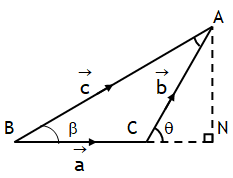
Resultant of two vectors inclined at an angle θ is given by the diagonal of the parallelogram formed by them. If 

are along adjacent sides of a parallelogram , then  will be the diagonal of the same parallelogram provided 

all have same order. act at an angle θ have, then

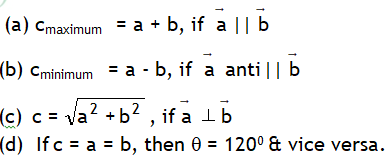
c2 = a2 +b2 + 2 ab cosθ    [Law of cosine


^Velocity selector

Velocity selector

A beam of charged particles is passed in a region of electric & magnetic fields acting at right angles (called cross fields) with such a velocity that the electric & magnetic force balances each other & the beam of charge particles pass undeflected through the region of cross fields. i.e.

Felectric = Fmagnetic   ⇒ qE = Bqv  ⇒


^Hall effect

Hall effect

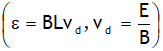
Is the phenomena of production of transverse emf in a current carrying strip of metal or a semiconductor when it is placed in a region of uniform magnetic field acting at right angles to current. It can be used to, calculate drift velocity of charge carriers, number density of charge carriers & nature of charge carriers.

^Deviation of charge in magnetic field

Deviation of charge in magnetic field

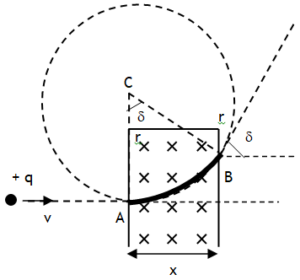
Consider a positive charge of charge + q & mass m fired horizontally in to a region of uniform magnetic field acting normally inwards to the plane of as shown in the diagram.

Let x < r be the thickness of the magnetic field region. Let δ is the deviation suffered by the charge particle as it comes out of the region of magnetic field. From diagram we can write

^Cyclotron

Cyclotron

Also called magnetic resonance oscillator) & is the first circular accelerator designed was by American Physicist Ernest O. Lawrence. + vely charged particles like proton, deutron & alpha particles etc. can be suitably accelerated by cyclotron. It can’t be used to accelerate light particles (e.g. electrons) & neutral particles (e.g. neutrons).

^Charge particle in magnetic field

Charge particle in magnetic field

A point charge moving in uniform magnetic field experiences a force on . Behaviour of charge particle depends on the angle ‘θ ‘ between .
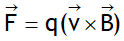
Case 1, if θ = 00 or 1800

When the charged particle  moves  parallel or anti parallel to field then no net force acts on it & its trajectory remains a straight line.

Case 2, If θ is other than 00, 1800 & 900  

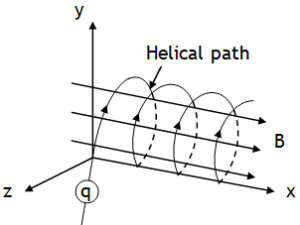
Charge particle moves in a helical path of radius , completes one circle in time & travels a distance in one time period in the direction of field called pitch & is given by,
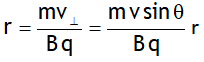
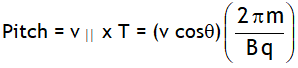
Case 3, If θ is 900

Charge particle moves in a circle at uniform speed.
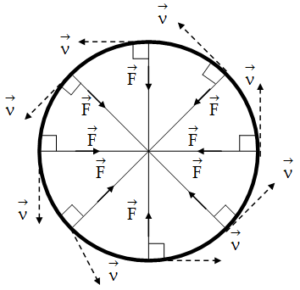
Radius of circular path is
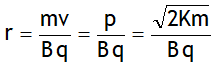
KE of particle is constant. It completes a cycle in time  at angular frequency .
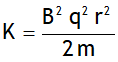
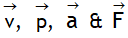
As the force acting on the particle is only normal & no tangential force is available thus speed & hence KE also of the particle will remain unchanged. As the kinetic energy of the charged particle remains constant. Hence no work is done in moving a charge particle moving at right angles to the magnetic field. However due to change in direction  &  are variables in direction.
^Toroid

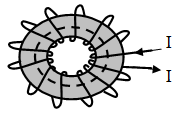
Toroid

Magnetic field inside is B = m0 nI & outside is zero.

^Solenoid

Solenoid

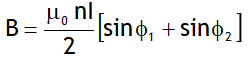
Mag. field on the axis of a solenoid is

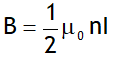
If solenoid is very long, loops are tight, then for a point situated on the axis & well inside, B = μ0 nI & for a point near end on the axis,

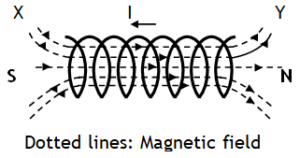
Field pattern of a long solenoid & a bar magnet are similar, with the difference that magnetic field is maximum at the end of poles where as for a long solenoid it is at centre.


^Thick solid conductor or rod

Thick solid conductor or rod

Magnetic field for a thick sold conductor or a rod of uniform current density using Ampere’s law is

Also inside a piper carrying hollow conductor magnetic field is zero inside everywhere, maximum at surface. Outside & at surface described by same functions as that of a rod.

^Ampere’s Circuital Law

Ampere’s Circuital Law

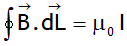
Ampere’s law is useful to find magnetic field in symmetrical situations. It states that the line integral of magnetic field for a closed plane curve is equal to ‘m 0’ times the current crossing the area bounded by the closed curve provided the electric field inside the loop remains the constant. i.e.

error: Content is protected !!
Call 9872662552