^Oblique projectile from ground

^Oblique projectile from ground

Suppose a body is projected from the ground from point O at an angel q with the horizontal and with the velocity u. Let at time t the projectile is at point P where its velocity is v directed at angle b to the horizontal.
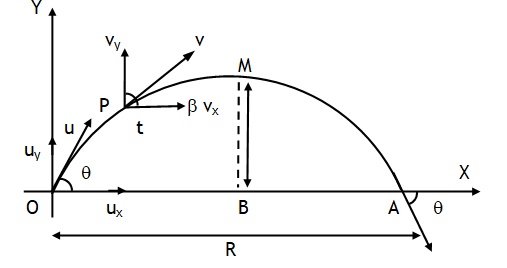
1  Using trigonometry x & y components of initial velocity are ux = u cosθ  & uy = u sinθ

Describing position

2.   Using vector addition law the position vector of point P w.r.t. origin is

3.  Using s – t relation for the motion O to P along x & y axis we can write

(a) x – t relation: x = u t

(b) y – t relation: y =

Eliminating t from above two relations we get y – x relation:

^Horizontal projectiles 

^Horizontal projectiles 

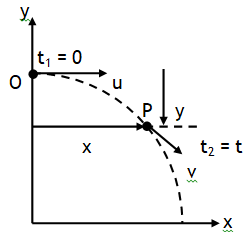
Suppose a body is projected from some height from point O horizontally with the velocity u. Let at time ‘t’ the projectile is at point P (x, -y) where its velocity is v directed at angle b to the horizontal.

For the motion O to P along x & y axis we can write

Using s – t relation

  1. x – t function: x = ut
  2. y – t function: 
  3. Using v – t relation
  4. vx – t function: vx = u
  5. vy – t function: vy = gt

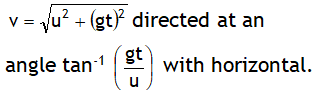
From the velocity triangle of  v, vx & vy we get


^For a body just released from a height

^For a body just released from a height

If a body is dropped from a height h,

1. it reaches the ground with speed [using v – s relation]

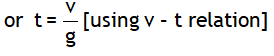
2. The time taken by it to reach the ground is [using s – t relation]


^Projectile thrown straight up

^Projectile thrown straight up

Suppose a body is projected upwards from the ground and with the velocity u. The characteristics of motion of such a body are as follows.

  1. The maximum height attained
  2. Time taken to go up (ascent) = Time taken to come down (descent)
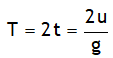
  3. Time of flight
  4. For an object thrown straight upwards with u = 50 m/s\
  5. The speed of the body on return to the ground = speed with which it was thrown upwards
  6. When the height attained is not large, that is u is not large, the mass, the weight as well as the acceleration remain constant with time its speed, velocity, momentum, potential energy and kinetic energy change with time.
    1. Let m be the mass of the body. Then in going from the ground to the highest point, following changes take place.
    • Change in speed = u
    • Change in velocity = u
    • Change in momentum = m u

    Change in KE = Change in PE =

    1. On return to the ground the changes in these quantities are as follows:
    • Change in speed = 0
    • Change in velocity = 2 u
    • Change in momentum = 2 mu

    Change in KE = Change in PE = 0

    1. If the friction of air be taken into account, then the motion of the object thrown upwards will have the following properties:
    • Time taken to go up (ascent) < time

    taken to come down (descent)

    • The speed of the object on return to the

    ground is less than the initial speed. Same is true for velocity (magnitude), momentum (magnitude) and KE.

    • Maxi height attained is less than .
    • A part of the KE is used up in overcoming

    the friction.


^What is a projectile

^What is a projectile

A projectiles is any object moving under the influence of gravity.  There are several ways to throw a projectile, vertically up, vertically down, horizontally, at some angle up, at some angle down etc.

  1. Object is thrown means initial speed non zero.
  2. Object is dropped means initial speed zero.Assumptions

    Following are few assumptions in the study of projectiles.

    1. Projection speed u << v escape so that g remains constant with the height & equations of UAM can be used to study the problems based on projectiles.
    2. Wind is absent for simplicity of mathematics.
    3. Air friction is absent if not specified so that the mechanical energy of the projectile remain constant throughout the motion. i.e.

    K + U = same at all the points of trajectory.

    4. The acceleration of any projectile on earth is a = constant = g = 9.8 m/s2 = 32 ft/s2 directed towards the centre of the earth irrespective of its mass, position, time, speed of projection & angle of projection. As the acceleration of a projectile is ‘g’ acting along – y, thus it has no x & z components.

^Trajectory

^Trajectory

Path traveled by a point particle is called trajectory (or locus). It is straight (if a & v are collinear) & curved otherwise.

^Moving upstream & downstream

^Moving upstream & downstream

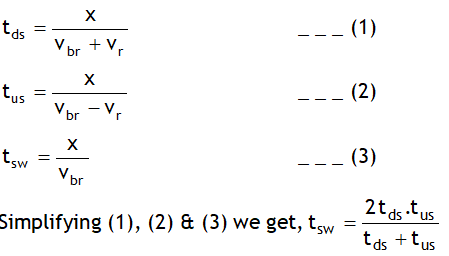
In such a case the boat is not crossing the river, rather it moves along or opposite to stream.  Distance covered in the opposite to direction of river current is called upstream & that covered in the direction of river current downstream.

i.e. for a particular distance the still water time is the harmonic mean of upstream and downstream times.

^Condition for shortest distance

^Condition for shortest distance

As the shortest distance between the two points is their perpendicular distance, thus he must reach exactly opposite bank as shown.

From the diagram one can write

^Condition for shortest time

^Condition for shortest time

At a = 00 the time taken to cross the river will be minimum & given by   

This is the case when the boat w.r.t. water is moved along the normal to river current as shown below.

From the diagram one can write


^Crossing a river

^Crossing a river

Suppose a person start rowing his boat from point O with velocity vbr (w.r.t. river i.e. without considering the effect of water) towards point S in order to cross a river of width ‘w’ flowing at a speed ‘vr’ towards x axis. Let under the effect of river current boat has net velocity the boat vb (w.r.t. ground i.e. resultant vbr & vr) & he reaches point R, then the distance SR covered downstream (i.e. distance along the stream) is called drift.

error: Content is protected !!
Call 9872662552