^Weight, W

^Weight, W

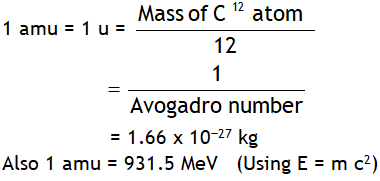
Weight of a mass (called victim mass, m) at a place is equal to gravitational pull experienced by it at that place due to the gravitational field of a source mass (M). It is given by

^Atomic mass unit (u)

^Atomic mass unit (u)

^Contact force

^Contact force

Force that is due to physical contact between the interacting bodies is called a contact force e.g. push, pull, friction, tension, up-thrust.

^Bohr correspondence principle

^Bohr correspondence principle

According to this principle the quantum theory must give same result as classical theory in the appropriate classical limit.  

^Field force

^Field force

A force that interacts without a physical contact is called a field force e.g. gravitational, electromagnetic.

^Limitations of Bohr’s theory

^Limitations of Bohr’s theory

  1. It is valid only for single electron system.
  2. Nucleus was taken as stationary but it also rotates about its own axis.
  3. Couldn’t explain fine structure of spectral line.
  4. Provides no information about the relative intensities of spectral lines.
  5. Provides no distribution of electrons in an atom.
  6. Fails to explain that why do the electrons move only in circular orbits.
  7. Bohr’s theory doesn’t explain the Zeeman effect (splitting up of spectral lines in magnetic field) & Stark effect (splitting up of spectral lines in electric field).
  8. Bohr’s theory doesn’t explain the doublets in the spectrum of the some atoms e.g. in sodium (5890 A0 & 5896 A0).
  9. Silent about the selection rules which governs the transitions.
  10. Use two theories

(i) Quantum (to explain the existence of stationary orbits) &

(ii) Classical (for motion of electrons in the orbits). These two theories essentially oppose each other.

^Fundamental forces

^Fundamental forces

Basic forces e.g. nuclear, electromagnetic, gravitational & weak.

^Free body diagram

^Free body diagram

FBD is a vector diagram showing all the forces acting on a particular system.


^Tangential force

^Tangential force

  1. A force acting along or opposite to velocity is called tangential force.
  2. A force acting along velocity increases speed with time.
  3. A force acting opposite to velocity decreases speed with time.
  4. Tangential force can’t change direction.
  5. The work done by a tangential force is positive if it causes an increase in the KE of a system & negative if there is a loss of KE.

^External force

^External force

  1. Any force acting outside the system selected is called external force.
  2. Only external force can accelerate a system.
  3. Force internal or external is a matter of selection of system. e.g. if we consider a system of earth & sun, then the gravitational force on earth by sun & that by sun on earth are internal, but if we consider the system earth only then the same gravitational force on earth becomes external force & accelerates earth around the sun.


error: Content is protected !!
Call 9872662552